Friday, January 20, 2006

Secrets of the Irish Bog Men

The remains of two men preserved in the peat bogs of central Ireland were unveiled this month in Dublin. Peat wetlands in northwest Europe are well-known for their bog bodies, the cold, acidic, oxygen-free conditions preventing decay and mummifying human flesh.

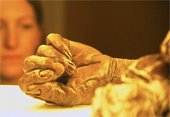
One bog body, named Oldcroghan Man, was preserved so perfectly that his discovery sparked a police murder investigation before archaeologists were called in. Living well over 2,000 years ago, he was in his early 20s, and stood 6 feet 6 inches (198 centimeters) tall. You can still see his fingerprint whorls.

"He had very well manicured nails, and his fingertips and hands were indicative of somebody who didn't carry out any manual labour," says said Isabella Mulhall, the museum's Bog Bodies Project coordinator. "So we presume he came from the upper echelons of society. He had no scars on his body either, just the equivalent of two small paper cuts to one of his hands".

National Geographic News

Thursday, January 19, 2006

Games of the Gods

The Olympic Games, originally created to honour Zeus, were important national festivals of the ancient Greeks. Traditions and ideals laid down in these early Games, like the truly remarkable and effective Olympic Truce, still inspire us today. But the origins of the Games, mythologically speaking, are rooted in violence, deceit and death.

In an effort to redefine the Olympics and restore some of the forgotten ideals which inspired the games of ancient Greece, a revival of an ancient tradition has been proposed, the Olympic Truce, when warring peoples laid down their arms and sought the paths of peace for the duration of the Games. Call me a spoilsport if you will, but the origin of the Olympic Games is not the best example of brotherly love and peace on earth to men of good will.

It all began with the dysfunctional family of Tantalus. We can't blame him for his great-grandson Agamemnon being murdered by another great-grandson, Aegisthus, who was in turn killed by a great-great-grandson, Orestes, nor can we hold him to account for the fate of his daughter, Niobe, who lost all her children and was turned to stone. But it was Tantalus, king at Mount Sipylus in Anatolia, who was solely and totally responsible for murdering, and cooking, his own son, Pelops.

It's an appalling story, for those whose stomachs are strong, continue reading Games of the Gods, the Origin of the Olympic Games

Wednesday, January 18, 2006

Last Charge of the Brave Heart


Dinna fear ye, Dinna fret ye
Black Douglas will no' get ye


Black Douglas: Sir James Douglas was known as the Black Douglas because of the terror his name aroused in the English. It was his task, in the end, of taking the Bruce heart, encased in a small casket made of silver, to Palestine.

The Bruce; History is strewn with warrior kings, born into times of upheaval, unrest and rebellion, their entire lives spent in battle mode. Robert the Bruce was one of these. When he died in 1329 of a virulent form of psoriasis, he left explicit instructions that his heart be taken to the Holy Land.

So off sailed the Black Douglas for Jerusalem bearing the heart of The Bruce.On the way to the Holy Land he ran into a spot of bother, arriving in Spain just as Alfonso XI of Castile was preparing to do battle against Osmyn, the Moorish governor of Grenada.

On March 25th, at Tebas de Ardales the forces of Islam and Christianity clashed. The Scots found themselves surrounded by Moorish cavalry and attempted to break through.

The Last Charge: Sensing impending defeat, Douglas led a last desperate charge. Rising on his stirrups he ripped the casket from the chain round his belt and, taking aim, hurled the heart into the melee, then charging after it.

The following day, when the main Spanish forces reached the site, the bodies of the Scottish crusaders were discovered on the battlefield. When the corpse of the Black Douglas was turned face up, the casket was found beneath his body, the heart still inside.

Robert the Bruce had lead his final charge.

Tuesday, January 17, 2006

Land of the Labyrinth


Crete 's mystery is extremely deep. Whoever sets foot on this island senses a mysterious force branching warmly and beneficently through his veins, senses his soul begin to grow. Nikos Kazantzakis

Ancient Crete was the crossroads linking three continents, and the cultural strands of Asia, Africa and Europe were woven here to produce a civilisation where the predominant deity was female. It lasted over 1500 years.

Arthur Evans was a middle-class Englishman and subject of Queen Victoria. While he ignorantly superimposed the English monarchical system onto Minoan society, he is admired for his intuition, his creative imagination and his profound scholarship.

It is to him that we owe the discovery of this marvellous civilisation, until his time only dimly reflected in legend. But he failed to grasp the nature of the Goddess-celebrating people who lived and worshipped here.

For Crete was the home of the Great Mother

Ariadne's Story is also part of this ancient island. To speak of Ariadne is to speak of Theseus, and of the Minotaur. Her story tells of blood and betrayal, of broken trust and cowardly abandonement on the glittering island of Crete, Land of the Labyrinth

Monday, January 16, 2006

Tristan and Isolde

A timeless tale of two lovers unknowingly drinking a magic potion and ultimately dying in one another's arms, the story of Tristan and Isolde is still told centuries after the songs and the ladies of the French Court are long, long forgotten.

The story of Tristan and Isolde is often held up as an example of true and perfect love. All the ingredients for a satisfactory narrative are present; the lightning bolt of desire, the inevitable tragedy, ritual sacrifice, the denial of satisfaction and the purity of renunciation. Essentially, we are told, this is a story with profound religious meaning.

Be that as it may, Tristan and Isolde is a ripping good yarn, a medieval Mills and Boone with enough minor characters and side plots to keep any writer of soap operas lucratively employed for a lifetime. There are all sorts of mystical reworkings and enthralling new spins on this irresistibly romantic old tale, it's been dished up to us in opera, science fantasy, romantic fiction, on stage and on the silver screen.

While you wait for the movie to reach you, read the rest of The Timeless Tale of Tristan and Isolde

Tablets of Stone

The Churches of Wales are many and beautiful. The photo is of Llangelynin Church near Rowen

The history of the Churches could be said to be a large part of the history of Wales. The two are so closely knit. The prehistoric Standing Stones, the Ancient Burial Chambers, the Hill Forts, and later the Castles and Churches of Wales. These are the remains, the bones, and also the monuments, the "tablets of stone" on which earlier people wrote.

Golf Origin Claim gets up the haggis

A Chinese researcher is challenging Scotland's proud claim to be the home of golf.

The Chinese were teeing off in 945CE, 500 years before the first Scot swung a club, Professor Ling Hong ling of Lanzhou University, claims. He says ancient records tell of a Chinese magistrate playing a game in which a ball is knocked into a hole with a stick. Ling says the game, called "hit-ball", reached Europe much later.

The Royal and Ancient Club in St Andrews had one comment "Golf originated here in Scotland!"

Sunday, January 15, 2006

Tristan and Isolde

The new film on the timeless tale of Tristan and Isolde is now showing. I have to wait until it crosses the equator before I get to see it, but I'm looking forward to another version of this old favourite.

The durability of the medieval romance says something about the human brain. Are we hard-wired for star-crossed love? That's worth a story in itself.

Year of the Dog

I was asked the other day for a quick overview of the Year of the Dog.

The date of the New Year is moving up fast, I was glad of the reminder. My year-long birthday will be over, no more endless carousing for another cycle, and for the next 12 years the Roosters will be on the wagon.

Traditional New Year is such a hectic time, it comes straight after Christmas, why not celebrate the Chinese New Year instead? February 28 is New Years Eve and I've arranged a quiet afternoon on the riverbank at the back of my house.

Why don't you drink a toast yourself to the Year of the Dog


Buy at Art.com
Morgan
$17.99
Buy
From Art.com

Fashion for Women Warriors

The Museo Nazionale in Naples houses this Attic red-figured bell-krater.

It depicts a mounted Amazon attacking two Greeks who fight on foot. The Amazon is brandishing her spear against one of the Greeks. She wears a finely patterned sleeved and trousered combination, and a turban-like cap.

Is she wearing camouflage? A fine weave? A dye pattern in spots?

Friday, January 13, 2006

WildCam

I can hardly believe this. I get so tied up in books I forget the technological miracle of the web, and specifically the webcam. My tenant Jeremy C Shipp at Haunted House Dressing may have a blog where hippos climb trees but if you can't find them instantly ..... you can watch the baboons instead with the National Geographic WildCam

Thursday, January 12, 2006

Sometimes his stories kill trees

Come on, how could you not be intrigued by a man who was cut out of a Jenny Craig commercial?

Meet my new tenant, Jeremy C Shipp (handle JC), the author of four fantasy novels, three science fiction and one straight fiction novels, thirty theatre/film scripts and more short stories than most of us can shake a stick at.

But I'm perplexed. He has been involved in a number of independent film projects, the favourite being "The Making of Jeremy the Movie: The Movie." It's a movie based on a documentary about the making of a movie called "Jeremy." None of which really exsists.

Drop in and say hello to Jeremy at Haunted House Dressing, see if he perplexes you

Mini church


Wouldn't you love to have this at the bottom of your garden?

Bremilham Church, on a farm at Foxley-cum-Bremilham near Malmesbury, Wiltshire, Great Britain. It measures just 4m by 3.6m with single pew has space for four people and standing room for six more.

For many years it was used by the farmer who owned it to house turkeys, but when the current owners took over the farm they had it blessed and began using it for services again - one each year to mark Rogationtide.

Friday, January 06, 2006

The Alexander Mosaic


In 2003, a team of artists from the International Center for the Study and Teaching of Mosaic (CISIM) in Ravenna, Italy, made an ambitious proposal to the archaeological superintendent of Pompeii: create an exact copy of the Alexander Mosaic and install it in its original home. More than two years, 16,000 hours of work, and $216,000 later, the most famous mosaic to survive from the ancient Roman world once again adorns Pompeii's House of the Faun.

One of the iconic images of the great Macedonian leader, the mosaic depicts a confrontation between Alexander and the Persian king Darius in the fourth century B.C. Since 1843, the mosaic has hung on the wall of the National Archaeological Museum in Naples, safe from the feet of Pompeii's two million plus yearly visitors, as well as from the rain and sun that have damaged the whole site.

So why bring Alexander back to Pompeii? The House of the Faun was once Pompeii's biggest and most impressive urban villa, filled with simple but elegant decorations designed to demonstrate the vast wealth of the house's owners. But today, although the sheer size of the house is still clear, the brightly colored paintings and mosaics, the gleaming marble and bronze statues, the fountains, and the hustle and bustle of a palatial villa are gone. Superintendent Pietro Giovanni Guzzo wants to change that. "I want visitors to have the impression that they are entering the same luxurious house in which the ancient Pompeian owners lived before it was destroyed by the eruption of Mount Vesuvius in A.D. 79."

See
Pompeii Sites

Wednesday, January 04, 2006

The Golden Age

In Greek Legend there is a story of an ancient Golden Age where people lived in peace and prosperity. To quote: "The first age was an age of innocence and happiness." The whole concept of this myth is that everything has become slowly worse and worse for human kind since the Golden Age. Up until recently modern academics have rejected these legends as pure "myth".

Yet the myth of the Golden age doesn't only come from Ancient Greece. Probably the most ancient religion that survives today is Taoism in China. Again this religion talks about a Golden age in the past. As explained repetitively in the Tao-Te-Ching written by Lao Tzu. The concept of the Golden Age is also in the story of the Garden of Eden. When Adam and Eve sinned they were banished into the waste land and Adam had to work "by the sweat of his brow". The story of the Garden of Eden comes from a Golden age story from ancient Mesopotamia.

Also in the few Aztec and Maya writing that have survived again there is a myth of a very ancient Golden Age ruled by a compassionate Mother Goddess. This is shown in contrast to the later age of warfare and human sacrifice. In fact most ancient cultures of the world have some myth of a Golden Age of the ancient past

n the 1960s an archeologists called Mellaart lead a team to excavate a site in Anatolia in Turkey. This site turns out to be the oldest city ever discovered. Called Catal Huyuk it goes back over 9,000 years. What was discovered goes against all assumptions archeologist have about people living in Neolithic times.

They couldn't find any fortifications to defend the city or any weapons of war. Neither could they find signs of violence committed on people buried in graves.

It was also a city full of feminine imagery to the degree that Mellaart was forced to say that the people worshipped the Ancient Great Mother.

So unsettling was these discoveries that the site was closed down for thirty years and the academic world ignored the implications of this find. But there was on archeologist who was brave enough to challenge the accepted wisdom of the academic world.

The late Marija Gimbutas went digging in other Neolithic sites and found similar findings. She also highlights the Neolithic findings that Soviet scientists had made in Transylvania. As well as Goddess civilizations were found in Crete and Malta, all showing peaceful societies that worshipped the Great Mother. Gimbutas became a very controversial figure and her books and work was rejected by the academic world.

Full Article by William Bond

Saturday, December 31, 2005

How divine

I've been given a copy of Divination For Beginners (For Beginners)

I always enjoy Scott Cunningham's work so I'm looking forward to getting stuck into this one. I'll let you know (I've already divined that)

Friday, December 30, 2005

No Jobs for Dogs

Chinese tradition holds 2006 will be a year of bad luck for people born under the sign of the dog, but misfortune has come early for some looking for jobs. Companies looking for new recruits had deliberately passed over candidates born as dogs in China's ancient 12-animal astrological cycle to ward off the bad luck expected for people in years of their same sign.

(The rooster will make way for the dog at Chinese Lunar New Year on 29 January)

Sunday, December 25, 2005

The Singing Reindeer

A White Christmas

More on Poinsettias

The Aztecs called poinsettias "Cuetlaxochitle." During the 14th - 16th century the sap was used to control fevers and the bracts (modified leaves) were used to make a reddish dye.

Montezuma, the last of the Aztec kings, would have poinsettias brought into what now is Mexico City by caravans because poinsettias could not be grown in the high altitude.

William Prescott, a historian and horticulturist, was asked to give Euphorbia pulcherrima a new name as it became more popular. At that time Mr. Prescott had just published a book called the Conquest of Mexico in which he detailed Joel Poinsett’s discovery of the plant. So, Prescott named the plant the poinsettia in honor of Joel Poinsett’s discovery.

Joel Roberts Poinsett was the first United States Ambassador to Mexico and during his appontment he wandered the countryside looking for new plant species. In 1828 he found a beautiful shrub with large red flowers.

The botanical name, Euphorbia pulcherrima, was assigned to the poinsettia by the German botanist, Wilenow. The plant grew through a crack in his greenhouse. Dazzled by its color, he gave it the botanical name, Euphorbia pulcherrima meaning "very beautiful."
Buy at Art.com

Buy From Art.com

Friday, December 16, 2005

Help The poinsettia poisoned me

OK. Some joker sent me this

Don't ever let your kids eat the poinsettias! They are deadly poisonous, and every year several poor unsuspecting little ones are killed at Christmastime by taking just the slightest nibble from a poinsettia plant.

Crikey! Luckily it's not true. It's a wonderfully persistent myth though, and it seems to have arisen from a long-ago death of a child's being attributed to the wrong cause. From a fact sheet prepared by Ecke Poinsettia Growers:

The poinsettia poison myth had its origin in 1919 when a two-year-old child of an Army officer stationed in Hawaii died of poisoning, and the cause was incorrectly assumed to be a poinsettia leaf.

Since that non-poinsettia death in 1919, there haven't been any real ones either. And no wonder: a 50 lb. child would have to eat more than 1.25 lbs. of poinsettia bracts (about 500 to 600 leaves) to exceed the experimental doses, according to the POISINDEX Information Service.

Send your name to the Asteroid Belt

Dawn Community
Send your name to the asteroid belt on the Dawn spacecraft. Your name will be recorded onto a microchip that will be placed aboard the spacecraft accompanying it on its mission to the asteroid belt. After entering your name below, you will have the opportunity to print a document that verifies your journey aboard the spacecraft

Friday, December 09, 2005

Favourite Book 2005 #1


Drone On!: The High History of Celtic Music
My #1 pick as Favourite Book 2005


This is a weird, wild, wonderful read. Despite her name, Winnie Czulinski is an avowed Celtophile and has written extensively in the field.

Reading Drone On, subtitled "The High History of Celtic Music," is like an evening in an Irish pub. The teller of tales mixes fact, fiction, speculation and downright lies to make the night a joy to recall and Winnie takes us on a breakneck tour of the various Celtic lands and legends. The book also looks at the Celtic contribution to country and American folk styles of music, as well as the transition of songs like "The Patriot Game" into "God on Our Side," with the tune coming from the Appalachians as "The Merry Month of May" and popularised as "Bold Grenadier".

This is a wonderful book in the old sense of the word, being full of wonder.

Tuesday, December 06, 2005

Some Railway Lore

Ghost Train

I was a railway fireman back in those days, working on the CPR line in Alberta. I did a hard day's work and earned me a fair wage. I was young then, and my pretty little bride was just setting up housekeeping in the little cottage that was all we could afford. Life was good, and I thought everything would continue rolling along that way.

Then came that fateful day in May of 1908. I was working nights that month, and my buddy Twohey was the engineer. We were about three kilometers out of Medicine Hat when a blazing light appeared in front of the engine. It was another train on a collision course with us. Twohey yelled at me to jump, but there was no time. The light was right on top of us. I thought we were dead. Then the oncoming train veered off to the right and ran passed us, its whistle blowing and the passengers staring at us through the windows. But there was only a single track in that stretch of hills, and it was the one we were on. I looked over at the shrieking, rumbling Ghost Train and saw that the wheels were not touching the ground!

Well, we were mighty spooked by the incident. Twohey decided to take some time off from engineering and began working in the yard; but I kept working the night shift as a fireman, not wanting some Ghost Train to drive me away a job I enjoyed.

A few weeks later, I was stoking the fire for an engineer named Nicholson when we heard the shrill whistle blast through the calm night air. We were on the same single track just outside of Medicine Hat, and the brilliant light of the Ghost Train burst out of nowhere, blinding us. Nicholson gave a shout of terror and I thought my heart would stop. As before, the Ghost Train veered off to the right at the last possible second. I saw it race passed us on tracks that did not exist, its passengers staring curiously at Nicholson and I from out of the windows.

That did it. I wasn't about to go back on the tracks after that. I did yard work for the rest of the month of May and a few weeks in June. Finally, I decided that enough was enough, and I gritted my teeth and resumed my role as fireman.

I was firing up an engine in the yard one evening in early July when the report of an accident came in. The Spokane Flyer and a Lethbridge passenger train had a head-on collision on the single track three kilometers outside of Medicine Hat, on the exact spot where the Ghost Train had appeared. The Lethbridge locomotive had derailed and its baggage car was destroyed. Seven people were killed in the accident, including the two engineers. One was my buddy Twohey, and the other was Nicholson.
retold by S.E.Schlosser


Australian Railway Folk Songs
POOR PADDY WORKS ON THE RAILWAY

In eighteen hundred and fifty-one,
I did what many men had done,
Oh, me dungaree breeches I put on,

Chorus: To work upon the railway, the railway.
I'm weary of the railway.
Oh, poor Paddy works on the railway.

In eighteen hundred and fifty-two,
I had some work that I must do,
So I shipped away wid' an Irish crew,

In eighteen hundred and fifty-three,
I packed my gear and went to sea,
I shipped away to Syd-en-ee

In eighteen hundred and fifty-four,
I landed on Australia's shore,
I had a pick-axe an' nothing more,

In eighteen hundred and fifty-six,
Me drinks I could no longer mix,
So I changed me trade to carrying bricks,

In eighteen hundred and fifty-seven,
Me children numbered jist eleven,
Of girls I'd four an' boys I'd seven,

In eighteen hundred and fifty-eight
I made a fortune, not too late,
An' shipped away on the Frances Drake.


The Afghans with their camels played a leading role in the building of the Australian Railways and they've been commemorated with the naming of the trans-continent train, The Ghan. It is said there are more wild camels in the Australian outback than the entire Middle East.


THE LONELY FETTLERS

We're just three lonely fettlers located right out West,
Midst heat and sand and desert we try to do our best;
Each morn at six you see us with shovels, bar and jack,
All day long through heat and dust, we toil along the track.

Our camp is on a sandhill, there's nare a soul to meet,
'Cept for a weary swagman who wandered off his beat;
Just twice a week arrives a train with our supplies,
Just old corn beef and taters, some bread, and jam and flies.

You've got the lot the guard says, then gives the rightaway,
That train's our only visitor till our next ration day;
So listen all you fettlers who've never been outside the old suburban,

Any day – come pop along our outback way,


You'll get a family greeting, be sure you will not rust,
For water is so very scarce, you'll eat your pound of dust;
Just keep your courage growing and keep your chin well up,
Then life will be worth living, for full will be your cup.

(By Railwayman Jim Gordon. The Retired Rail and Tramwayman magazine April 1940)


The Railway Hotel plays an important place in Australian architectural heritage and folklore. Usually these buildings, with their distinctive awnings and signs, dominated the main street that inevitably grew up around the train station. It was at these hotels that travellers over-nighted, railway workers were sometimes lodged, commercial travellers used as a base, and the town gathered socially.


The German like his beer
The Englishman his half and half
The Irishman likes his tot and
The Scotsman likes his hot
The Aussie has no national drink
So he drinks the bloody lot!

A man and his wife check into the Railway Hotel. The husband wants to have a drink at the bar but his wife is extremely tired so she decides to go on up to their room to rest. She lies down on the bed... just then, an elevated train passes by very close to the window and shakes the room so hard she's thrown out of the bed.

Thinking, this must be a freak occurrence, she lies down once more. Again a train shakes the room so violently she's thrown to the floor. Exasperated, she calls the front desk and asks for the manager. The manager says , "I'll be right up."

The manager is sceptical but the wife insists the story is true. "Look... lie here on the bed -- you'll be thrown right to the floor!" So he lies down next to the wife. Just then the husband walks in. "What do you think you're doing!", he says. The manager calmly replies, "Would you believe I'm waiting for a train?"

Warren Fahey

The Railway Children
A Ghost Story


One of the more famous urban legends in Texas is that of the haunted railroad crossing in San Antonio just South of the San Juan Mission. It is here that the ghosts of children, killed when a North bound train collided with their stalled school bus, push cars across the same tracks to a safety they could not reach themselves. According to the legend, a bumper dusted with talcum powder will reveal tiny hand prints of the ghost children, left when they pushed the car across the tracks.

At the website folklore the hardy chaps are trying to document the phenomena should it really exist. (That's what they do, document ghosts)
The Once and Future King

The Legend of Arthur and his court at Camelot lives on - it's a human story and a classic tear-jerker after all. It would beat any television soap opera hands down. A man who dreamed of peace and order, his life marked with tragedy and wild misunderstanding, with a wife who didn't love him, a best friend who betrayed him, a son who killed him, yet who still managed to be an ideal king.

The personality of Arthur is unknown and unknowable. But he was as real as Alfred the Great or William the Conqueror; his impact upon future ages mattered as much, or more so. Enough evidence survives from the hundred years after his death to show that reality was remembered for three generations, before legend engulfed his memory.

Caerlon was the site of one of Britain's three Roman Legionary Fortresses and many believe it to be the location of Camelot.


Interview with King Arthur Pendragon

It's not every day that you get to sit in a pub garden with the King of England, supping pints of cider and smoking endless cigarettes. UK Online Senior Editor Chris Russell did just that and found King Arthur Uther Pendragon a thoroughly decent monarch.

'I'm not a king of the country, I'm a king of the people,' with a shrug of the shoulders the third reincarnation of Arthur Pendragon leans casually back in his seat and flicks the ash from his cigarette to the floor.

'Legend says King Arthur will return to Britain when he's needed. Obviously that time is now.'

The former Hells Angel, soldier and gardener is quite relaxed about his role as leader of the people. Unlike traditional monarchs he's very laid back and doesn't stand on ceremony, a far cry from the pomp and circumstance demanded by Queen Elizabeth II. But then, Arthur says he's very different.

'The current Queen is forced down people's throats. She's the queen because the population of the country are told she's the Queen. Me, I'm Arthur Pendragon and if people want to believe I'm some nutter who thinks he's the reincarnation of King Arthur that's their choice.

'My belief is unshakeable. It could be questioned but but it doesn't matter. I'm not out to convince anybody I am the contemporary King Arthur.

'I've known since childhood that I was different but I didn't know what I really was. I had dreams of the Dark Ages and it was all very confusing. It only dawned on me in 1986 what it was all about and it hit me like a bolt of lightning.'

Not for this King shining platemail armour and festooned horses, however. Instead this King insists he's Arthur the warrior. A warband leader, who travelled the country with his loyal Shield Knights sorting out problems caused to the populace by Saxon invaders who tried to create a nation of slaves.

But when it comes to battle, Arthur, who gives his real age as 1,542 but admits to being a spritely 42 in this incarnation, says passive actions speak far louder than violent ones.

Strapped to his side is Excalibur, the famed sword of old that was passed to the previous Liege by the Lady of the Lake. That weapon, it seems, is gone for ever. Instead Arthur uses the sword made for the Hollywood movie Excalibur. A four-and-a-half feet long Celtic broadsword it has been specially blessed and granted magical powers by several druidic orders - orders to which the King belongs.

'I have said that I will never draw my sword in anger,' he explained. 'I have it by my side always and it is a magical weapon but that doesn't mean it has to be used.

'There's no point in violent protest, it doesn't really solve anything and it just creates bad publicity. It's much better to protest peacefully. That way you make your point and win people round to your way of thinking.'

Arthur has certainly been involved in some protests in his time. Most notably in 1990, he spent the winter sleeping under a tree whilst maintaining a picket of Stonehenge. Many would have given up when it got cold and damp, but then, not everyone is the King of England.

'It was bloody cold and it was bloody damp but it had to be done. I survived a lot of the time on handouts from the Americans who seemed totally phased that they could walk along and almost fall over a bloke in robes who said he was King Arthur.

'By the time the winter was over I was in a bit of a state and I lost a lot of weight, but on the plus side I made my point and met a lot of interesting people.'

These days the cold isn't so much a problem as Arthur spends most of his time on the road, travelling from protest to protest and providing a focal point for demonstrators.

'If people need me, I give them my help. When I'm around it's not uncommon for someone to call me and say :'Oy mush, get your bum over here and give us a hand.' That's all I need and I'm off.'

King Arthur Pendragon
Being the one and only authorised Web site of King Arthur Uther Pendragon, The Once And Future King.

The Accolade, 1901


The Accolade, 1901

Buy this Art Print at AllPosters.com


Tristan & Isolde


Tristan & Isolde

Blair-Leighton, Edmund

Buy this Art Print at AllPosters.com


"What would ye that I did?" said Sir Lancelot.
"I would have you to my husband," said Elaine.
"Fair damosel, I thank you," said Sir Lancelot,
"but truly," said he, "I cast me never to be wedded man."
"Then, fair knight," said she, "will ye be my paramour?"
"Jesu defend me," said Sir Lancelot, "for then I
rewarded your father and your brother full evil
for their great goodness."
"Alas," said she, "then must I die for your love."

Le Morte D'Arthur.
Book XVIII Chap. XIX.

The Camelot Project is designed to make available in electronic format a database of Arthurian texts, images, bibliographies, and basic information.

Monday, December 05, 2005

Beowulf, Ghosts and Ogopogo

Beowulf on the web

The earliest surviving epic poem written in English, Beowulf was most likely "composed in the seventh or eighth century, but being more precise depends on where one believes the poem was composed. ...[A] contender, which has come seriously into the reckoning as a result of the Sutton Hoo discovery, is seventh century East Anglia. Not only was the ship burial (which dates to 625AD) uncannily like the burials of Scyld and Beowulf, but the grave goods revealed the East Anglian court of the Wuffingas to be unexpectedly sophisticated and closely linked to the Swedish royal house at Uppsala. It is now thought possible that both these royal lines shared a common ancestry. As the scholar Howell Chickering asked: 'Was it through the early East Anglian court that detailed knowledge of Scandinavian tribal history in Beowulf became available in England?' And one might add, was the poem composed as a way of telling East Anglians something of their semi-historical, semi-legendary Scandinavian ancestors? There is, perhaps, a good case for believing that Beowulf was composed in Suffolk, at the palace of Rendlesham, within living memory of the great ship-burial in 625AD."

(from Angelcynn's Historical Background to Beowulf which has unfortunately vanished from the web)

If only these resources were available when I was at school, it would have been easier if we had computers back then too

Syd Allan's excellent starter site

David Breedon's wonderful modern translation

Beowulf in Hypertext: text in Old English and modern translation

Ghosts of Tombstone
Like so many other places in the Old West with violent histories, Tombstone is said to be one of the most haunted in Arizona. At its most famous place - the OK Corral, several witnesses have reported ghosts of the Earps as well as the Clanton brothers. At the nearby Boothill Graveyard, reports of apparitions and strange lights have frequently been given in this place that harbors several old outlaws beneath its wooden tombstones.

At the historic Buford House, an 1880’s adobe home, which now serves as a Bed & Breakfast, the ghost of a man named George Buford apparently refuses to leave. In the late nineteenth century, George, a gold prospector, lived in the house with his father when he fell in love with the girl across the street, Cleopatra, more familiarly called Petra. After returning from a long prospecting trip, George accompanied Petra and some other friends on an outing. For some reason, the girl decided to accompany another man on the walk home. George, sure that he had lost his promised girl, became angry, despondent and reclusive. Soon, when Petra visited him, he shot her twice, then turned the gun on himself. Despite her wounds, Petra recovered, but George died of his self-inflicted gunshot.

Like others who died tragic deaths, George continues to walk the earth, apparently lost in space and time. Both the owners and guests have seen him walking inside the home, as well as along the street in front of the old adobe structure. Often, the doorbell rings in the middle of the night, seemingly, of its own accord. Others have reported hearing knocking on walls, faucets turning themselves on and off, and strange lights appearing. Once in a while, women report that that they have felt someone touch their hair or stroke the back of their necks when no one is around.

Legends of America


Ogopogo on the list of endangered species

British Columbia's Lake Okanagan. The lake is a remnant of the last Ice Age, more than 10,000 years ago, and lies on the Pacific slopes of the Rocky Mountains. It is seventy-nine miles long, two-and-a-half miles wide, and in places, more than 800 feet deep, providing more than ample room for any large water beast, which the eyewitnesses claim resembles a huge snake.

As early as the 1700s, the Okanagan Indians knew of a water beast living in the lake. They called the creature N'ha-a-itk, meaning "snake of the water," and their Native superstitions demanded certain traditions before entering N'ha-a-ith's domain. One of the traditions was the ritual sacrifice of a small animal as a peace offering before crossing the lake. Tying their horses behind their canoes, they would paddle out to where they believed the serpent lived in a cave beneath the water---known as Squally Point---and make their offering, thus insuring that their horses would not be dragged under and drowned by the monster.

In 1890, Captain Thomas Shorts was steaming on the lake when he saw a finned creature about sixteen feet long with a head like that of a ram. The creature promptly disappeared when he turned his ship in its direction, and virtually no one believed him when he reported it. But other reports soon followed at two or three a year, and people began to examine the lake in more careful detail. Today, the local population fervently believes in the creature's existence. They call it Ogopogo, and have named the island where its traditional home is Squally Point, Ogopogo Island.

Lake Okanagan's relative position with respect to that of Loch Ness has some scientists believing that the presence of an unidentified sea creature living in the depths of the lake is not as outlandish as it seems. Nessie, the famous Loch Ness monster, also thrives in a deep glacial lake, and some zoologists actually theorize that Loch Ness may be connected by underwater channels to the sea---that the Loch Ness monster is, in fact, a sea serpent of some kind traveling back and forth between the lake and the ocean. They also claim that hundreds of other lakes located in the same approximate latitude bands as Loch Ness could have similar connections to the sea and could be the home of mysterious sea creatures.

There have been reported sightings of creatures like the Loch Ness monster in approximately sixty other lakes around the world...places like Lake Storsjon in Sweden, Lake Rybinskoye in the Soviet Union and Lake Tsuchiura in Japan. All these lakes fall into the same latitude band as Loch Ness in Scotland, as does Lake Okanagan. But finding the creature, or the carcass, has proved elusive. Most monster lakes are far too large to be systematically searched, and many, like those in Scandanavia, are far too remote and rarely visited.

It is clear that a lot of people have seen something in Lake Okanagan that they suspect is a water monster, but what is it exactly that they are really seeing? Scientists know there are several species of fish which, when left undisturbed, grow to enormous size. The best example is the sturgeon, which averages ten feet in length, but has been known to grow much larger. In 1956, two Indians fishing in a canoe in Lake Seton, British Columbia, saw a sturgeon twenty-two feet long. Ten years later, another couple on the lake in a twenty-five foot boat sailed alongside a sturgeon that was ten feet longer than the boat. In Russia, a sturgeon was caught in the Volga River that was twenty-four feet long and weighted 3,241 pounds. And scientists also point out that there are eels of enormous size, too.

But the Canadian government is taking no chances. It has declared Ogopogo an endangered species, and hunting it is against the law. Most of the people who live on the shores of Lake Okanagan need no further proof. They've constructed a life-sized model of the creature, although it looks more like a dragon than a sea serpent, and have made it the star of an annual festival called, appropriately enough, "Ogopogo Days." For them, Ogopogo is very real indeed.

Unexplained

Saturday, August 27, 2005

Thinking about the Sun

I spent last evening at a childrens' concert. You know the sort of thing, you sit watching a dozen or so little children graded in sizes presenting little performances, followed by another dozen or so little children presenting another little performance. And so on.

Everyone is marking time really, the children are lovely but the seats are uncomfortable, the sound system is erratic and we're all waiting to see our own kids on the stage. None of us, of course, can contain the sudden pang, almost painful, when the tiniest children are ushered on to sing a song. The sight and sound of these littlest ones on their very best behaviour brings us to our knees.

The theme of the evening was Cosmic Conundrum

We heard songs about the Sun, Moon and Stars - the Age of Aquarius, Gooday Sunshine and the wonderful standard, Blue Moon. To tell you the truth I can't recall all of the other songs, the children I had come to see were only involved with the songs mentioned.

All of this made me think about the Sun, and the ways we have regarded this giant nuclear reactor over the ages. I never understood the significance of Midwinter until I experienced it in England, a long way from home in a cold dark country where I could never ever, no matter what I did, get warm. I still wonder how it's possible, in a place where water can actually freeze in the tap, to raise the energy necessary to speak more than a few words much less come up with something along the lines of 'Tyger! Tyger! burning bright In the forest of the night, What immortal hand or eye Could frame thy fearful symmetry?'. A mystery indeed.

In Australia the Sun is She. A woman who awakes daily in her camp in the east, lights a fire, and prepares the bark torch she will carry across the sky. Before setting out, she paints herself with red ochre, which she spills, colouring the clouds red. Upon reaching the west, she reapplies her paint, again spilling reds and yellows in the sky. The Sun Woman then begins a long passage under the ground back to her camp in the east. During this subterranean journey her torch warms the earth, causing plants to grow

In the Hollow Hills

If you want to enter the Hollow Hills even though you know what may befall you ....

First, before you decide to take the chance anyway, visit The Hollow Hills

Saturday, August 06, 2005

Mysterious Places on google earth

The mysterious places aren't so mysterious when seen on google earth. Indeed some of them are practically invisible.

Here's the co-ordinates of some well known ancient places, just copy them into the google earth search and you wil be taken there instantly


Nazca Lines: -14.73, -75.14
Where are they? Nothing like Von Daniken said

Giza Pyramids/Sphinx: 29.975, 31.13
by far the most impressive

Stonehenge: 51.004, -1.018
once again, where is it?

Rapa Nui (Easter Island): -27.11, -109.35
just an ocean, can you even see the island?


Troy: 39.955, 26.24
or the beaches of useless fruitless avoidable death to Australians (credit for the needless slaughter goes to Winston Churchill)

If you have found some ancient places, please let me know. Likewise if you can actually see anything

Thursday, August 04, 2005

Nine Mile Canyon


Located in a remote part of Utah, Nine Mile Canyon is often called “the world’s longest art gallery” as it contains more than 10,000 images carved onto canyon walls by Native Americans. The canyon also contains many historic sites – including stagecoach stations, settlers’ cabins, ranches, and iron telegraph poles installed by the famed 19th-century Buffalo Soldiers – that stand as reminders of the area’s pioneer history. Now this historic canyon is under increasing pressure from tourism, recreation, and energy development that threaten its significant prehistoric and historic resources


Nine Mile Canyon

Tuesday, August 02, 2005

Ancient date palm sprouts again

Israeli researchers have germinated a sapling date palm from seeds 2,000 years old

The seeds were found in archeological excavations at Masada, the desert mountain fortress where ancient Jewish rebels chose suicide over capture by Roman legions in CE 73. Carbon dating of a fragment from the Masada seeds put their age at between 1,940 and 2,040 years - indeed the oldest seeds ever brought back to life.

Stonehenge latest

Stonehenge has always mystified.

Julius Caesar thought it was the work of druids, medieval scholars believed it was the handiwork of Merlin, while local folk tales simply blamed the devil. Now scientists are demanding a full-scale research programme be launched to update our knowledge of the monument and discover precisely who built it and its burial barrow graves

Story at Megalithic.co.uk

And lovely photos of Stonehenge at Stonehenge.ukf.net

Wednesday, June 22, 2005

The Battle of Salamis

They were hopelessly outnumbered, but even then the Greeks knew it would be the battle that could change history.

The Asian invaders, had entered the Aegean. The "comeliest of boys" had been castrated; the throats of the "goodliest" soldiers ripped out.

Mounted on his marble throne Xerxes, Persia's formidable warrior king looked over the bay of Salamis, confident that he was about to enslave Europe. But instead of victory came defeat. As the Greeks' triremes trapped the Asian fleet, smashing it with their bronze rams, Xerxes watched incredulously. His soldiers, he said, were fighting like women.

That was 480 BC. Nearly 2,500 years later, a scientific team is searching for the lost fleets of the campaign in the northern Aegean.


Taipei Times

Lion Goddess to the Rescue

In Ethiopa a 12-year-old girl was abducted , kept captive for a week and beaten repeatedly by seven men trying to force her into a marriage with one of them. This is a common occurrence in Ethiopa, where gitls of even younger ages are kidnapped, beaten, raped and then forced into marriage with the rapist, all part of the marriage customs !!

The United Nations estimates that more than 70 percent of marriages in Ethiopia are by abduction, rape and force.

Three lions, hearing the noise of her beatings, appeared and chased off her captors. They stayed next to her as she lay semi conscious throughout the day until she was found by police and relatives on the outskirts of Bita Genet, 350 miles southwest of Addis Ababa.

"If the lions had not come to her rescue, then it could have been much worse." said Tilahun Kassa, a local government official. "They stood guard until we found her and then they just left her like a gift and went back into the forest. A young girl whimpering could be mistaken for the mewing sound from a lion cub, which is why they didn't eat her".

I say ir was Sekhmet !!!!

Saturday, June 18, 2005

Don't mention the war !!

Around the 9th century AD the Norsemen were all kitted out by master sword makers from the Rhine. in fact German arms dealers have been blamed for the Viking invasion of Britain .

Archaeologists working with the Russian Museum of Ethnography found the swords that the boyos used were made in Germany, swords of the highest quality which didn't break even during the fiercest fighting.

Tuesday, June 14, 2005

Fridays are NOT fraught with peril

We may make jokes about Friday the 13th and only kiddingly instruct loved ones to exercise greater care on that day, but those who suffer from a fear of the number thirteen (triskaidekaphobia) or a fear of Friday the 13th (paraskevidekatriaphobia) may genuinely feel limited by the rumored potential for ill luck connected with the date.

The reasons why Friday came to be regarded as a day of bad luck have been obscured by the mists of time — some of the more common theories link it to a significant event in Christian tradition said to have taken place on Friday, such as the Crucifixion, Eve's offering the apple to Adam in the Garden of Eden, the beginning of the Great Flood, or the confusion at the Tower of Babel.

Chaucer alluded to Friday as a day on which bad things seemed to happen in the Canterbury Tales as far back as the late 14th century ("And on a Friday fell all this mischance"), but references to Friday as a day connected with ill luck generally start to show up in Western literature around the mid-17th century:

"Now Friday came, you old wives say, Of all the week's the unluckiest day." (1656)

But it's not ! Friday is a day dedicated to Freya , the Wild Woman of the North. Perfume your house with rose petals for the Lady

The Anger of Pele

Can a souvenir casually pocketed on a Hawaiian beach bring misfortune? Though the more skeptical will scoffingly dismiss the notion as pure hooey, thousands have come to believe that yes, volcanic rocks taken from Hawaii fetch with them a curse of impressive proportions. And the only way to undo the jinx is to return the purloined items whence they came.

Legend has it that Pele, goddess of fire and volcanoes, is so angered when the rocks (which she sees as her children) are taken from her that she exacts a terrible revenge on the thief. She is especially protective of volcanic rock and sand, two items tourists almost unthinkingly pocket as mementos of their vacations. After all, who would miss a rock?

Pele will.

Hawaii Volcanoes National Park and far too many hotels to name receive a never-ending stream of packages containing sand, shells, and rocks from guilty-minded vacationers who are intent upon reversing their sudden downpours of bad luck. Many of these returns are accompanied by notes begging forgiveness of the goddess or detailing litanies of calamities that have befallen these casual purloiners:

Please take this sand and put it back somewhere on your island. I have had very bad luck since it came into my life and I am very sorry I took it. Please forgive me and I pray that once I send it back where it comes from, my bad luck will go away.

Please return to soil. I have been having bad luck.

Ever since we have taken items, we have had nothing but back luck and medical problems. We apologize for taking items, so we are returning same to Hawaii.

We placed the rock last fall on a cast iron chair in our garden, this spring the chair's leg had fallen off. This is the least of the problems we have had since we have taken the rock.

Pele's curse is not a mild-mannered one. Those afflicted by it don't misplace their car keys or develop runs in their stockings — their bad luck is of the grievous variety. Pets die. Jobs are lost. Houses burn down. Sudden and devastating illness strikes loved ones. Marriages break apart.

The Los Angeles Times reported on the sad case of Timothy Murray, a 32-year-old who scooped some of the unusual black sand from Hawaii Volcanoes National Park into a bottle and brought it back with him to Florida. Everything in his life immediately went into a nosedive: his pet died, his five-year relationship with a gal he was to marry ended, and the FBI arrested him in a computer copyright infringement case.

The native Hawaiian view of taking such souvenirs is that it's tantamount to stealing from Pele while visiting her home. Only the return of the stolen items appeases her wrath.

Saturday, April 02, 2005

Another God for the Modern World

Beiwe brings greenery to the Arctic.

As a Spring and Sun goddess, she has a special association with the fertility of plants and animals. Reindeer are her favoured creatures and she travels with her daughter Beiwe-Neida through the sky in a cart made of their antlers.

The Saami apparently called on Beiwe for help with the insane. A handy deity to be friends with in the 21st century.

Thursday, March 31, 2005

Nicaraguan Celebrations


Nicaraguan legend and folklore offers a parallel recount of the official history narrated on paper by chroniclers of the extensive and complex interaction there was between the indigenous cultures of Nicaragua and their conquerors—These tales have passed down from generation to generation through our oral history, awakening the imagination of a popular memory of transcendental events marked by tragedy, forsaken love, frustration, and horror

Nicaraguan Celebrations

Saturday, February 19, 2005

Ancient City uncovered

Archaeologists have begun underwater excavations of what is believed to be an ancient city and parts of a temple uncovered by the tsunami off the coast of the centuries-old pilgrimage town of Mahabalipuram,

As the waves receded, the force of the water removed sand deposits that had covered the structures, which appear to belong to a port city built in the seventh century, said T. Satyamurthy, a senior archaeologist with the Archaeological Survey of India.

Mahabalipuram is already well known for its ancient, intricately carved shore temples that have been declared a World Heritage site and are visited each year by thousands of Hindu pilgrims and tourists. According to descriptions by early British travel writers, the area was also home to seven pagodas, six of which were submerged by the sea.

Monday, February 07, 2005

You need a Dragon in your underpants !

If your horoscope is looking a bit worrying for the coming Lunar New Year, a Hong Kong company has just the thing to put it right: feng shui underpants.

The lucky smalls have been designed by Yeung Tin Ming, a master of the ancient Chinese craft of spirit manipulation, or feng shui, and will ward off evil spirits and bring harmony, claims Life Enhance, a company that seeks to bring the wisdom of ancient China to the mass market.

"Our feng shui master says that having something lucky in contact with your skin would bring spiritual balance, so we thought lucky underpants would be ideal -- they are as intimate as you get," said Amy Law, a spokeswoman for the company. Feng shui advocates believe good fortune can be generated by arranging everyday objects in a way that guides invisible energies and "spirits" that emanate from all things.

It is a key part of the ritualism surrounding the Lunar New Year, as each 12-month cycle ushers a different set of spiritual forces and believers will spend time re-arranging furniture and schedules to optimise spirit flows. On Wednesday millions of Chinese around the world will welcome the new year of the rooster, the next in a recurring 12-year horological cycle each of which is represented by a different animal of the zodiac.

Ancient belief has it that each year reflects the character of its associated beast and as roosters are considered unpredictable the coming 12 months are expected to volatile.

The underpants, which come in red, grey and white and in boxers for men and briefs for women, depict a dragon on the front in accordance with Chinese belief that the mythical creatures balance out the erratic nature of roosters.

If you have a dragon on your underpants you will be protected !


Sunday, January 30, 2005

God of Javascript

Originally I thought Thoth would be the God of Javascript. He is, after all, the god of writing. But Ogma is really much better suited.

In France, Ogma is shown as an old bald man, greatly wrinkled and browned by the sun. In Ireland we find him as a muscular young chap shouldering his sheilalagh.

Ogma is the god of communication and writing and he invented the script named after him -- the Ogham Alphabet. The Druids could read it, but no one else. And it's still indecipherable to 99% of the population. Sound like javascript to you ?

Gods for the Modern World

A colleague of mine was wrestling with a bit of javascript recently and complained that " ... the Javascript Gods were having a little fun with me". He wondered if he should try sacrificing a mouse before writing another script to keep them happy.

That's what we're missing in modern society, gods to assist us through the everyday trials and tribulations of the 21st century. Like javascript for example, or traffic gridlocks. Who would you entreat ?

If only there were deities I could sacrifice chicken livers to, and so stock up on goodwill for when I need to ask a favour. Like a god for power blackouts, for clogged vacuum cleaners, for keeping the cat in at night and, last but certainly not least, a god for giving up smoking

Monday, January 03, 2005

How to help after the tsunami

As we welcome in the first month of the New Year, my heart is heavy with sadness on the worst natural disaster of our times.

To help with the aid work after the sea rose up to claim so many lives, I urge you to support the Tamil Rehabilitation Organisation or UNICEF

Amazon and paypal are also taking donations, if you regularly use these services, a one-click system is put in place.

Sunday, January 02, 2005

New Year Customs - Did you do them ?

Stocking Up: The new year must not be seen in with bare cupboards, lest that be the way of things for the year. Larders must be topped up and plenty of money must be placed in every wallet in the home to guarantee prosperity.

Paying Off Bills: The new year should not be begun with the household in debt, so checks should be written and mailed off prior to January 1st. Likewise, personal debts should be settled before the New Year arrives.

New Year Customs - First Footing

The first person to enter your home after the stroke of midnight will influence the year you're about to have. Ideally, he should be dark-haired, tall, and good-looking, and it would be even better if he came bearing certain small gifts such as a lump of coal, a silver coin, a bit of bread, a sprig of evergreen, and some salt. Blonde and redhead first footers bring bad luck, and female first footers should be shooed away before they bring disaster down on the household.

The first footer (sometimes called the "Lucky Bird") should knock and be let in rather than unceremoniously use a key, even if he is one of the householders. After greeting those in the house and dropping off whatever small tokens of luck he has brought with him, he should make his way through the house and leave by a different door than the one through which he entered. No one should leave the premises before the first footer arrives — the first traffic across the threshold must be headed in rather than striking out.

First footers must not be cross-eyed or have flat feet or eyebrows that meet in the middle.

Nothing prevents the cagey householder from stationing a dark-haired man outside the home just before midnight to ensure the speedy arrival of a suitable first footer as soon as the chimes sound. If one of the partygoers is recruited for this purpose, impress upon him the need to slip out quietly just prior to the witching hour.

Sunday, December 26, 2004

Nectar of the Gods loses popularity

In Mexico, the "nectar of the gods" is in danger of extinction.

The popularity of the pre-Hispanic alcoholic drink, pulque, is fading in favour of more conventional beverages. Legend has it that pulque was being drunk in Mexico 10 centuries ago. It was certainly the preferred tipple of the Aztec elite and, being of divine origin, was used by priests in rituals. Commoners only stole a sip on pain of death!

Pulque is the sap of the maguey cactus, which grows in dry desert plains. It's extracted by workers who put a fat wooden tube in to the heart of the plant, and suck the liquid out. One litre of the milky liquid costs less than half a dollar.

But the so-called "nectar of the gods" is in danger of dying out as beer, rum and the ubiquitious tequila are taken up by young people.

Wednesday, December 22, 2004

Santa Free Zone ?

A group of Germans are fighting to get rid of Santa saying he has become a symbol of the commercialisation of Christmas.

Thousands of stickers have been printed declaring whole areas in Germany and Austria "Santa Free Zones" and pamphlets have been handed out on street corners reminding people that the traditional bringer of presents is St Nicholas and not the red-suited, white-bearded immigrant from the Americas.

Bettina Schade from the Frankfurter Nicholas Initiative said: "We object to the material things, the hectic rush to buy gifts, and the ubiquity of the bearded man in the red suit that are taking away from the core meaning of Christmas."

Santa Claus is not a typical Christmas tradition in Germany or Austria - the overweight red-suited man only turning up in the last decade or so.

Wednesday, December 15, 2004

Winter Solstice Concepts -- Beli Mawr

The Celtic commemoration of the rebirth of the sun is the Birth of the Divine Child, He who is known as Beli Mawr, The Shining One, Great Lord of Divine Fire.

On the longest night of the year, the Goddess gives birth to the Sun Child and hope for new light is reborn. The Birth is celebrated with games, merry-making and feasting which usually includes pork, the flesh of the sacred sow, and apples, the fruit of the tree of Avalon, the Blessed Isle of Death and Rebirth.

Monday, December 06, 2004

Christmas Spider

A charming old German story tells us that a long time ago, a mother was busily cleaning for Christmas. The spiders in the house fled upstairs to the attic to escape the broom. When the house became quiet again, the little spiders sneaked out and slowly crept downstairs for a peek. Oh! What a beautiful tree!

In their excitement, they scurried up the trunk and out among the branches. They were filled with happiness and glee as they climbed amonst the glittering beauty that surrounded them. But alas! By the time they were through with their explorations, the tree was completely shrouded in their dusty grey spider webs.

When Santa came with the gifts for the children and noticed the tree covered with spider webs, he smiled to see how happy the spiders were. But he also knew how heartbroken the mother would be if she saw her tree all dusty and grey. And so he magically transformed the webs to silver and gold thread. The tree now sparkled and shimmered and was even more beautiful than before.

And now that's why we have tinsel on our trees and also why every tree should have a Christmas spider hiding happily in its branches.

Tuesday, November 23, 2004

Goddess Brighid still going strong

Brighid is the goddess who survived the onslaught of Christianity. So greatly was she loved by the Irish people that they would have none of Christianity if they couldn't keep Brighid.

In relatively recent times her fame spread to Africa and Haiti in the hearts of slaves and deported Irish and Scottish indentured servants.

However she went through a radical transformation, and her aspect of Maman Brigitte is seen more as a Goddess of Vengeance.

The Haitian Voudou lwa -immortal spirit- "Maman Brigitte", is the wife of Baron Samedi, recognised worldwide as the jovial skeleton who wears a top hat, sunglasses, and smokes cigarettes or cigars.

Like the original Brighid, Maman Brigitte is revered for her ability to heal. Vodouisants approach her to request healing from life-threatening circumstances for she has the power to bring people back from the brink of death.

Monday, November 22, 2004

Sleep Spell

Color of the day: Lavender
Incense of the day: Maple

Everyone has a hard time falling asleep occasionally. Here's a spell for restful sleep. Begin by playing quiet music for a few minutes, and then go to bed. Imagine yourself as a beach of pristine sand, and sleep as the tide comes in to cover you. Say this rhyme:

Soft as sea on sand,
soft as mother’s love,
soft as moonlight above,
soft as the loving hand.
Sleep, gentle healer of flesh and mind,
come and restore what the day has drained.
Fill the long night till the Moon wanes,
then flee with dawn, leaving peace behind.

By: Elizabeth Barrette

Try out new things on 21 November

Color of the day: Yellow
Incense of the day: Clove

This is a day for inventions. On this day in 1783, the French physicians Jean-Francois Pilatre de Rozier and Francois Laurent, the marquis d’Arlandes, made the first untethered hot-air balloon flight, flying five and a half miles over Paris in about twenty-five minutes. Also, in 1877 on this day, Edison invented the phonograph, the first device to record sound. In 1969, the first link for the arpanet was connected (the arpanet later evolved into the Internet).

This is an auspicious day for trying out new things, new technology, and new ideas. So make an effort to shake yourself out of your ruts.

Magenta Griffith


Sunday, November 21, 2004

Achille's Rage

In the Iliad, Achilles expresses an all-encompassing narcissistic rage, which blinds him to all human caring for many weeks or months. We may be inclined therefore to ask: What in Achilles' past could have led him to have such ruthless and overpowering rage? In attempting to answer that question and fathom the causes of rage, we might consider the psychodynamics of his relationship to his mother and her influence upon him.

Achilles' mother, the immortal nymph Thetis killed six of her sons as she thrust them into the fire, attempting unsuccessfully to make them divine. Finally, in her seventh attempt, with Achilles, she succeeded – but only in part. Because she grasped Achilles by his heels as she held him in the fire, his ankles were not sufficiently immortalized. As a result, Achilles remained vulnerable in his heels, where we could receive a mortal wound

What effect might this experience and divine parentage have had upon Achilles? Clearly, Thetis valued her own immortality and was so intent upon her children – born of a mortal father - also being immortal that she was willing to kill them in the process. Can we surmise here that she indeed disdained humanity and the facets of her children that were not immortal? Could she have imparted this shame to Achilles? Was she, in contemporary terms, a narcissistic parent, attempting to meet her own needs through her children, at their expense?

What influence might her behavior have had upon half human, half divine Achilles? Perhaps he wanted to believe that he was divine and superhuman, and experienced deep shame and humiliation in regard to his mortality and human limitations. Such shame could lead him to deep sensitivity in regard to feeling devalued – intense reaction to personal slights, difficulty letting go of violations and humiliations.

Often the narcissism of a parent leads to narcissistic vulnerability and rage in a child, who never feels valued for what he or she is, because he can not fulfill the parental ideal. Thetis' lack of appreciation and empathy for Achilles' suffering could also have influenced him developing a blinding self-centeredness, and callousness to the suffering he caused others.

Because of his rare, mixed heritage, Achilles may also have felt very separate from others, resulting in difficulty at times identifying with and caring for his comrades - except for Briseis and Patroclus with whom he formed deep attachments. In fact, his feelings for both were so profound that the threat of loss of each one sent him catapulting into maniacal rage. Here, too, we see indications of a young man who was not truly nurtured, who formed intense symbiotic bonds in an attempt to compensate for what he had never had.


Cure for unsightly warts

Skin warts were considered unsightly as far back as the 13th century. Here's a cure that dates from about 1250:

Procure a live eel - fresh or salt water – and cut off its head. Then anoint those parts of the body afflicted with warts, using the fresh blood of the eel. Allow to stand until the blood dries. Do not wash off for at least three days. Bury the head of the eel deep in the earth. Remember where you buried it, so you can check its decomposition. As the head of the eel rots over time, the warts will disappear.

(This cure generally works better in the summer months, because the eel's head rots faster)

Atlantis again - this time in the Sahara !

The Lost City of Atlantis is not deep beneath the ocean -- the ancient metropolis is buried under the sands of the Sahara Desert!

Archaeologist Dr. Carla Sage points out that according to ancient accounts, the Mycenaean, Cretan and Egyptian civilizations all traded with Atlantis -- which would have been unlikely if it lay in the North Atlantic as many believe.

"Atlantis was clearly within easy trading distance of Troy and the other city states of the Mediterranean," she says. "I believe Atlantis was the capital of a vast North African empire with ports on the Gulf of Sidra. Atlantis was destroyed, not by earthquake, floods or volcanoes, but by the steady march of desert sands that smothered the civilization. The empire did not sink into the sea as is commonly believed -- it was swallowed by the dunes."

While the theory flies in the face of traditional views of Atlantis, Dr. Sage points to tantalizing evidence that supports the Sahara model.

Nomadic desert Bedouins, especially after sandstorms, often see marble columns sticking up out of dunes, notably near the Ahaggar Mountains of southern Algeria, the British expert reveals.

Even more surprising, scientists have discovered that within comparatively recent times in geological terms, the Sahara region enjoyed a temperate climate that would have made it an ideal site for human civilization.

"Eleven thousand to 12,000 years ago, when the ancient Greeks say Atlantis flourished, the Sahara was lush, fertile land," Dr. Sage observes. "Artwork etched in Saharan rocks at that time depicts giraffes roaming freely. Archaeologists have also found pictograms of domesticated cattle, horse-drawn chariots, as well as large caravans -- confirming that trade played an important role in the region."

But the alarmingly rapid transformation of the region from paradise to dry desert would have wiped out all agriculture and killed off livestock.

"More significantly, as sand encroached on the empire, clogging caravan wheels, it made travel nearly impossible -- which would have put an end to an empire based on trade," Dr. Sage says. "It was not until centuries later, around 100 B.C., that people began to use camels for transportation in the region -- an innovation that came too late for Atlantis, long since buried and forgotten under the dunes."

"A few diehards continue to believe that Atlantis was literally a continent in the midst of the Atlantic Ocean. "

If you read the full story you can see the original source, a somewhat off-putting source which has no claims to credibility. Still, it's a good story Full Story

Thursday, November 18, 2004

My Lord Bag of Rice and the Centipede

I thought a centipede was a creepy crawly behind my cupboard but once it was a terrifying, man-eating monster the size of a mountain. It lived in the mountains of Japan near Lake Biwa. The dragon king of that particular lake asked the famous hero Hidesato to kill it for him. The hero slew it by shooting an arrow, dipped in his own saliva, into the brain of the monster.

The dragon king rewarded Hidesato by giving him a rice-bag which could not be emptied and which fed his family for centuries. The dragon king also gave Hidesato a roll of silk that never ended, a cooking pot the needed no fire, and a bell hidden under a lake.

From then on Hidesato was known as My Lord bag of Rice

Full Story at Folklore @ Bella Online

Wednesday, November 17, 2004

Our Neolithic Pets

The discovery of a Neolithic cat burial on the island of Cyprus has more than doubled the known history of cat-human companionship. French archaeologists found the remains of a 9,500-year-old wildcat buried a little more than a foot away from a high-status person of indeterminate sex. Both cat and human were buried with their heads facing west, which may suggest they had a close bond in life. The oldest previous examples of domestic relationships between cats and humans are from Egypt circa 2000 B.C.E.

Meanwhile, archaeologists excavating a Welsh crannog, or bog dwelling built on stilts, may have found evidence of a royal fondness for the corgi dog that predates Queen Elizabeth II's by more than a millennium. A foreleg bone discovered at Llangorse Lake--possibly the site of the royal residence of the Welsh kingdom of Brycheiniog in the late ninth century--is from a small, corgi-size dog. ("Corgi" comes from the Welsh for "dwarf dog.") Archaeologists plan to consult the Welsh Corgi Club and compare the bone to more recent corgi remains.

Tuesday, November 16, 2004

The story of Atlantis, a prosperous land that disappeared without trace, sunk into the sea by the anger of gods, is one of our oldest myths. It occurs in many civilisations, this Paradise Lost, and many different societies have used the myth for many different purposes. In our times we have innumerable books, discussion groups, films and websites, many of a highly speculative character. Best know is the classical Atlantis story told by ancient Greek philosopher Plato.

In Plato's version we have a moral tale, not a report of historical events, but rather a moral that uses the story of Atlantis in the background. Was it true ? And if so, where was it ? Atlantis has been assigned to almost every possible place on earth, up to and including Antarctica. But Plato has told us where to find it.

" Atlantis is an island outside the Pillars of Heracles and when afterwards sunk by an earthquake, became an impassable barrier of mud to voyagers sailing from hence to any part of the ocean."

The name isn't derived from the Atlantic Ocean but from the giant Atlas, who held the sky upon his shoulders. Later, as Greek geographical knowledge grew, it gave also name to the high Moroccean mountain range -- and there's the clue, geography.

The most accepted location of Atlantis is Santorini. In 1650 BCE a series of earthquakes shook the region setting off a cataclysmic volcanic eruption on the island of Thera. This explosion can be directly connected with the decline of Bronze Age Greece. You can find information and some excellent photographs of Thera listed below this article

However, Geographer Ulf Erlingsson, discards Santorini in favour of Ireland. Plato describes the measurements, geography and landscape of Atlantis as 200 miles wide, 300 miles long, including "... in the centre of the whole island, there was a plain which is said to have been the fairest of all plains and very fertile". This may be a description of Atlantis, but it's also a descrption of Ireland.

Erlingsson believes the legend of Atlantis came from Dogger Bank, an isolated shoal in the North Sea, about 60 miles (100 kilometers) off the northeastern coast of England. Dogger Bank sank after being hit by a huge flood wave around 6,100 BCE.

“I am amazed no one has come up with this before, it’s incredible,” said Erlingsson

Photographs of Santorini

Was Atlantis in Ireland ?

Was Atlantis in Gibraltor ?

Monday, November 15, 2004

On the cover of the new Encyclopedia of Religious Rites, Rituals and Festivals you'll find pictures of a Catholic Mass, a blessing of the sea in China, Mardi Gras in Brazil and a "Star Trek" convention.

Through the book's 500 pages, there are the more-or-less expected descriptions of black churches, Jewish rituals, Protestantism and even Paganism. Then there are the more, shall we say, unorthodox entries, like puberty rites, snake handling, television and sports watching, and cannibalism.

Cannibalism?

The entry explains: "Cannibalism has been categorized using various schemes based on the function of the practice (ritualistic, nutritional or gustatory) and whether or not the victim is an 'outsider' or an 'insider' (exocannibalism and endocannibalism, respectively)."

When an anthropologist edits an encyclopedia of religious rituals, the meaning of both "religion" and "ritual" can be expected to be cross-cultural and interdisciplinary. We're talking way outside of church. Even the just-completed political season was a religious ritual for many Americans, said Frank Salamone, the anthropologist and sociology department chairman at Iona College who edited the book. "Politics is a civil religion," he said. "Being out there on a cold New Hampshire morning, kissing babies, shaking hands, singing 'God Bless America' — it's all ritual. For the people who follow every step, there is great meaning."

That's what it's all about: The search for meaning. Salamone, 65, a faculty member at Iona for 23 years, believes the search for something greater than ourselves can lead people to religious rituals of all sorts.

He refers to the "rites of passage" framed by Belgian anthropologist Arnold van Gennep, who held that a person can be changed or enter a new phase of life by going through three steps: Removal from society, immersion in a separate society or class (perhaps at a "Star Trek" convention) and a return to society as a different person. "Born again," Salamone said. "Whether you're going to Mecca or on another pilgrimage, everyone on the same road, on the same path, is part of a brotherhood or sisterhood. Rituals take you from one place to another. There's a reality behind what you see. People are changed."

He spent three years putting together the encyclopedia, which is published by Routledge (Taylor & Francis Group) and sells for $150. It is designed to be used primarily by high school and college students.

Salamone, who has studied religion for four decades, decided what subjects would be covered and assigned some 80 contributors from around the globe to write entries on their areas of expertise. He had to edit each piece and make a slew of deadlines while teaching at Iona.

Salamone's patterns of study are broad. He is speaking at an anthropological conference in Atlanta next month about how members of the Hausa ethnic group in Nigeria use magic to cast spells on one another during wrestling matches.

"At root, all rituals are the same," he said. "All of theatre comes out of the sacred. Football takes that place for a lot of people. It's the same magic you get from hearing a Christmas carol you knew as a child." He also is a practicing Catholic with an unorthodox, you might say anthropological, bent.

"There have been open-minded Catholics throughout history who have been willing to learn from other traditions, from Aquinas to St. Thomas Moore, all the way to John XXIII," he said. "That's the kind of Catholicism I embrace, the idea that anything good comes from God."

Saturday, November 13, 2004

Lakshmi for Luck !

Lakshmi is addressed as mata (mother) instead of just devi (goddess).

As a female counterpart of Lord Vishnu, Mata Lakshmi is also called 'Shri', the female energy of the Supreme Being. She is the goddess of prosperity, wealth, purity, generosity, and the embodiment of beauty, grace and charm. She is an essentially domestic deity and householders worship Lakshmi for the well being and prosperity of the family.

Businessmen and women also regard her equally and offer her daily prayers. Money, grain, cattle, land, gold, and silver are forms of wealth. Who doesn't need them? It is said that wealth comes if Lakshmi grants it.

A devotee prays to her thus:
'Pradurbhootosmi Rashtresmin Kirtivriddhim dadatu me' (I am a citizen born in this country. Grant me fame and wealth)and 'Vasa me grihe'(Reside in my house). Those who praise Lakshmi live long. Their health is good. They will lead a glorious life.

Thursday, November 11, 2004

Race to save Iranian Treasures

A team of Iranian archaeologists announced their preparedness to join the experts currently working at the Izeh historical site to help identify, document and save the ancient Elamite site which is being submerged as the Karun 3 Dam becomes operational and its reservoir fills up.

The region is home to an ancient site from the Elamite era which includes graves, ancient caves, as well as several items dating back to the Stone Age, although they will be flooded when the dam’s reservoir is filled.

Ali Mahforuzi, head of the archaeology team, said that Khuzestan is the paradise of archaeology in Iran.

The dam experts have announced that the reservoir would be filled within the next six months; therefore, archaeologists have very little time to survey the historical site and rescue as many artifacts as they can. When the Aswan Dam was being constructed in Egypt, the temple of Ramses II with a 22-meter statue was removed from its original place in an emergency operation with the cooperation of UNESCO.

However, Mahmud Mireskandari of the underwater archaeology team at the Cultural Heritage and Tourism Organization (CHTO) stated that Iran possesses neither the necessary underwater archaeology expertise nor proper equipment so it will be almost impossible to save the site unless foreign experts are invited.

“Definitely, the water pressure, the bad climate, and the changing temperature of the water will wash up the whole site, especially the hills, and there will be no way to save them, so only the historical artifacts will be rescued before it is too late,” he added. Dr. Mostofi, who had conducted several research projects at the site almost forty years ago, said, “Hearing such sad news was a big shock to me. By submerging the site, it seems we will soon lose sight of our Elamite historical sites forever. Each ancient site is like our fingerprint, showing our national identity. Safeguarding the site is the duty of every individual, and I believe all archaeologists are prepared to help.”

According to the original schedule, the dam was to become operational last August, but then the action was postponed until November, and over the past three months CHTO experts and archaeologists have been conducting activities at the site.

The story of Izeh being submerged gradually seems like a bitter dream for many. Although it seems too late, any effort by any individual to save at least part of our ancient heritage is praiseworthy. The dam is located about 28 kilometers east of the city of Izeh on the Karun River.


Tehran Times
.

Builders destroy historic palace

Builders who unearthed the 500-year-old Ming Dynasty ruins of an imperial palace in the ancient Chinese capital Nanjing went ahead to stay on a contract schedule and totally destroyed the site.

Workers unearthed several large marble pillar bases but still failed to put down tools, and by the time they'd finished, had dug a huge pit 2,000 square metres (21,500 square feet) wide and three to four metres (9.9 to 13.2 feet) deep out of the palace foundations.


The remains were believed to be part of the eastern palace of the Ming Dynasty imperial palace, which was built by Zhu Yuanzhang, the first emperor of the Ming Dynasty.


Local relics protection officials had rushed to the site to stop the work after local residents tipped them off. Wang Zhigao, a relics protection expert from Nanjing Museum, said he and his colleagues reached an agreement with the construction team to temporarily suspend work but the request was then ignored until police got involved.


The State Administration of Cultural Heritage said the workers faced prosecution for deliberately damaging cultural relics. Much of China's cultural heritage has disappeared with many relics smuggled overseas. Illegal excavations are rampant while the drive for profit has seen countless ancient sites damaged or destroyed.

(photo : AFP


Monday, November 08, 2004

Ancient Hot Chocolate

When Cortez and his army arrived in the land of the Aztecs, they were unimpressed by the little dark brown beans many of the Aztecs were carrying, until they learned they were used like money!

These beans were cacao beans, a popular trade item before getting ground, roasted, and made into hot chocolate (without milk-- no cows!) As popular as it was for the Aztecs, chocolate, or xocatl, was originally developed as a food by the Maya.

Sometimes it was made without honey, as a bitter drink, and occasionally even contained chiles, to make it spicy. The Aztecs, Maya, and others also added a cinnamon-flavored bark (canela) native to Mexico and Mesoamerica, but this is not readily available, so the cinnamon in this recipe is the oriental variety available in modern supermarkets.

2 ounces (squares) bitter, unsweetened bakers' chocolate
1 cup hot water
3 tablespoons honey
dash salt
3 cups hot water
4 sticks cinnamon bark

Chop the chocolate and heat it in 1 cup of water until melted. Add honey and salt. Beat the hot chocolate with a balloon wire whip as you add 3 cups of hot water. Serve the foamy hot chocolate with cinnamon-bark stick stirrers.

Want to give some ancient cooking a try ? Check the Forums at archeology.org for advice on ancient cuisine

Thursday, November 04, 2004

Cosmetic lasts 2000 years

This little pot is an extraordinary archeological find. Just six centimetres across and five centimetres high, and containing a cream made from animal fat, starch and tin oxide, it was found in an ancient drain at the site of a Roman temple complex in London.

Marks left by the last fingers to use the cream pot are still visible on the lid ! Fashionable women of Roman Britain used it to bestow a pale and appealing look after their session in the baths. Someone would certainly have been in hot water for losing the jar !

White face paint was fashionable in Roman times and this colour would normally have been derived from lead acetate, but for Romans exploiting British mineral resources, the tin would have been a more than acceptable substitute.

Tuesday, November 02, 2004

The Aboriginal Trail

I found an excellent guide to plants used by the Aboriginal people. The plants in this guide are listed by their botanical names, because common names often vary in different parts of Australia. The Aborigines spoke many languages, and so they also have many different names for plants. Some Aboriginal names have become our common names Geebung, for instance, for Persoonia species

At least half of the food eaten by Aborigines came from plants. Just as we eat root vegetables, greens, fruits and seeds, so did the Aborigines. Fruits, seeds and greens were only available during their appropriate seasons, but roots could usually be dug up all the year round, because the earth acted as a natural storage cupboard. Important foods were replanted. The regular digging-over of the soil, and the thinning out of clumps by collection of plants, together with burning to provide fertiliser, is not very different from what we do in our own gardens, and the whole country was in a way an Aboriginal garden.

Plants were used for many other things besides food. The long leaves of sedges, rushes and lilies were collected to make baskets and mats, and soaked and beaten to free the fibres to make string. The bark of trees made buckets, dishes and shields; River Red-gum bark was particularly good for making canoes, and old scarred 'canoe trees' can still be seen. Some rice-flower shrubs (Pimelea spp.) have such strong fibres on the outside of the stem that they have been called 'bushman's bootlace', and were used by the Aborigines to make fine nets in which to collect Bogong Moths to eat.

Medicines also came from plants native mints (Mentha spp.) were remedies for coughs and colds, and the gum from gum-trees, which is rich in tannin,was used for burns.

The particular plants which were eaten varied, of course, in different parts of Australia; in this guide it's only possible to mention a few of them.

Find bunya pine, banksia, geebung, yam daisies, pepper trees and more at The Aboriginal Trail

Monday, November 01, 2004

Happy Bast Day !

The feast day of Bast is celebrated on October 31. The Egyptians whooped it up with merry making, music, drinking, feasting and dancing.

Cats are magnetic animals with a strong power to fascinate or repel, and most of us faced unexpectedly with one admit that we either love them or we can't stand the sight of them.

Historically, the cat was first endowed with archetypal power in Egypt where it came to be regarded as a Sacred animal. For the cat is identified with Bast

Bast is the goddess of the rising sun, the moon, truth, enlightenment, lesbians, sexuality, pleasure, fertility, bounty, birth, plenty, the home, music, dance, the arts, hemp, and serpent-slayer of the sun. She was the beloved goddess of Ancient Egypt and the protectress of women, children, and domestic cats.

Usually shown as a cat headed woman holding a sistrum percussion instrument, she represents the Maiden aspect of the Triple Goddess. But Bast moves, with the moon, to the fruitful woman with swelling womb.

Bast was the possessor of the Eye of Horus, the sacred utchat. Over time the utchat became more associated with cats and was often cat shaped. Egyptian women used these cat amulets as fertility tokens, praying to have as many children as cats have kittens.

Our modern names for the cat are derived from the word utchat: cat, chat, cattus, gatus, gatous, gato, katt, katte, kitte, kitty, etc. one variation of her name was Pasht, and from this we get the remaining Indo-European words for the cat: pasht, past, pushd, pusst, and puss.

The negative, darker side of Bast is her twin sister, Sekhmet. As the lioness goddess, Sekhmet symbolises the destructive forces in Nature, and together the sister goddesses make up a whole - the balance of light and dark

Sekhmet is the Goddess of sunset, destruction, death, rebirth and wisdom. She is typically shown as a black skinned woman with the head of a lioness and eyes and hair of orange or red. The cycle of life and death was created when the primeval Goddess Sekhmet-Bast divided into the two sisters. Sekhmet represents the Crone aspect of the Triple Goddess.

The feast day of Bast was celebrated on October 31st, with music, song and much enthusiastic dancing. A great week-long festival was held in the holy city of Bubastis attracting devotees from all over the country to celebrate along the riverbanks and through the city streets. Herodotus tells of crowds swelling to 700,000. You could perhaps say that Hallowe'en was originally celebrated as the Feast of Sekhmet and Bast.

Today, ruins mark the joyful city of Bubastis, the once-proud temple is nothing but tumbled blocks and Bast is largely forgotten.

Take a moment to honour this ancient egyptian goddess. Light a green candle, her sacred colour, and be affectionate to a cat, her cherished animal.