Sunday, October 08, 2006

Mithras

The cult of Mithras was popular throughout the Roman world from the Middle East, via Italy, to its northern limits at Hadrian’s Wall and along the German border. At least until Constantine decided that Christianity would suit his rule better.

In essence, Mithraism was centred on the worship of the saviour god Mithras, born of a Virgin and a God, whose birthday is 25 December. Sound familiar?

Because of political aspirations, and a desire to confine the power of the Army, the state religion was named as the new cult of Christianity.

More on Mithras, God of Soldiers

Thursday, September 28, 2006

Paranormal survey

Monash University, in Melbourne, Australia is conducting an online survey of the paranormal.

Whether you believe in the paranormal or not, take a few minutes to complete this survey designed to help shed light on what types of experiences people are having (or not having as the case may be).

By paranormal the survey means experiences that cannot be explained using the current laws of science. These events include premonitions, out-of-body and near-death episodes, telepathy and apparitions. Many people believe in the paranormal but this survey is not about beliefs. It is about what people ARE and are NOT experiencing. The survey is open to anyone 18 years of age or older, regardless of whether they have or have not experienced the paranormal. The survey is anonymous and will take only 5 to 10 minutes to complete.

Survey Link

Tuesday, September 26, 2006

The lunar effect


Does a full moon make you feel like partying? Do you feel more energetic during a waxing moon? Either way, Making plans around the phases of the moon can lead to many things, from good business deals to more lustrous hair.

Roch Voller, who works in the psychiatric emergency department of Melbourne's St Vincent's Hospital, understands first-hand the meaning of the term "the lunar effect". He always expects more patient aggression when it's a full moon.

Voller isn't alone in believing in the lunar effect.

A 1987 study by the Journal Of Emergency Medicine found that 92 per cent of nurses found full moon shifts more stressful and believed they should be paid more to work on those nights.

It seems it's not just those prone to lunacy who are affected.

Shareholders are also influenced. A 2005 study by the Journal Of Empirical Finance found stock returns were consistently three to five per cent lower around the full moon than on the days around a new moon.

news.com.au

Monday, September 25, 2006

Bollywood portrays baby Krishna


Bollywood too has been contributing to the wider knowledge of mythology. After the phenomenal success of 'Hanuman' last year, Hindi film world would again witness one of the greatest heroes of all times, Krishna, an richly animated musical, aimed at children.

It's always entertaining to hear the stories of Krishna again. This becomes especially exciting when it is presented in an animation format, with Krishna in his childhood.

'KRISHNA', tells the story of Lord Krishna's birth, his childhood spent in Vrindavan and his slaying of Kansa, the evil ruler of Mathura. The film features various adventures of his childhood, including his clashes with demons like Pootna, Trinavarat and many more. This animated feature also brings to life Lord Krishna's naughty aspects like stealing butter, and other adventures.

Kannum vittum, onam unnanum

OnamThe Onam festival traces its way back to Hindu mythology and the fifth avatar of Lord Vishnu. It is a festival of colours, flowers and celebration as King Mahabali is welcomed back home.

The Vamanamoorthy temple (photo) in Kerala, is believed to be the very location where Asura king Mahabali offered his head to MahaVishnu's Vamana avatar to place the third feet of land that the noble king granted the brahmin boy.

Ceremonial celebrations at the temple go on for 10 days coinciding with the Onam festival.

On the ninth day of Uthiradam and the tenth day of Thiruvonam, the caparisoned elephants at the temple are taken in a procession to the music of Panchiratalam - the five instruments played by about 60 artisans.

The Pookkalam or flower carpets are the very soul of the Onam festival.

Arrangements are made in every home to welcome not just King Mahabali but also the peace, prosperity and happiness that he symbolises.

Mythology in the sand

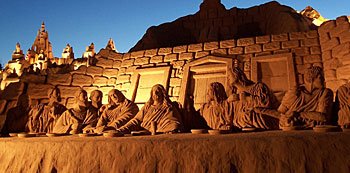
Sand sculptureThe beautiful reproduction of the Last Supper is made of sand, just one of the exhibits in the International Sand Sculpture Festival (FIESA) 2006.

The sculptures were constructed in two months by 40 sculptors, all with a mythological theme. Scenes of Greek, Celtic, Scandinavian, Assyrian, Indiana, Egyptian and African mythologies were displayed to the public during four months.

FIESA is a mega-exposition of sand sculptures made by internationally recognized sculptors in an exhibition area of 15,000 square metres with sculptures up to 15 metres in height. This year 35,000 tons of sand were been used to create theme of “Mythologies”.

Black cats and luck

There are many tales of shape-shifting black cats in communication with the Devil in European folk-belief. But black cats have a positive image as well. Charles I owned a black cat. Although we usually associate spaniels with the English king, he looked upon his cat as great good luck and lived in fear of harm befalling his little companion.

The day after the black cat died, Charles was siezed.

There are many cat charms relating to ships and the sea. Fishermen's wives would keep a black cat at home to prevent disaster at sea, these cats became very valuable and were often stolen. For good luck, cats were kept on board ships. If a sailor were approached by the ship's cat it meant good luck, but if the cat only came halfway and went away again it meant bad luck.

The very worst thing to happen, guaranteed to raise a storm and bring bad luck to everyone, was to throw the cat overboard.

More on Animals in Mythology

The Bat and Death


Being associated with death means being associated with rebirth. The appearance of a bat signifies the need for transformations, for letting go of old habits or ways of life and adopting new ones. Bat shows how change is necessary although it can be painful to let go of the past. As an animal of night and the dark it can also guide people through the darkness of confusion and help them face their fears.

The Bat means the opportunity for change and transformation, a coming out of the dark and being reborn. When you meet a bat, welcome him as the Blessed Bringer of Change.

More on Bats in Mythology

Celebrant versus Celibate

I had a strange reaction from a clerk in the post office who was bemused when I dropped in to pick up a parcel sent to me. It was a biggish box, and the address had Reverend clearly written in front of my name.

Clerk : I didn't know you were a priest.

Me : A minister, yes. But chiefly I'm a Funeral Celebrant.

Clerk : A celebrant? I thought you had children.

Time flies

Time flies. It certainly does.

I've spent the last four months doing a Funeral Director's course, which is quite different from the grief counselling. But all tied in with my celebrancy.

Back to the blog .............

Tuesday, April 04, 2006

Orion Nebula

Orion Nebula This is a peek inside a cavern of roiling dust and gas where thousands of stars are forming.

The image, taken by the Advanced Camera for Surveys (ACS) aboard NASA's Hubble Space Telescope, represents the sharpest view ever taken of this region, called the Orion Nebula. More than 3,000 stars of various sizes appear, some of them never before seen in visible light, in a dramatic dust-and-gas landscape of plateaus, mountains, and valleys that are reminiscent of the Grand Canyon.

The Orion Nebula is a picture book of star formation, from the massive, young stars that are shaping the nebula to the pillars of dense gas that may be the homes of budding stars.

The bright central region is the home of the four heftiest stars in the nebula. The stars are called the Trapezium because they are arranged in a trapezoid pattern.

Ultraviolet light unleashed by these stars is carving a cavity in the nebula and disrupting the growth of hundreds of smaller stars. Located near the Trapezium stars are stars still young enough to have disks of material encircling them. These disks are called protoplanetary disks or "proplyds" and are too small to see clearly in this image. The disks are the building blocks of solar systems.

Monday, April 03, 2006

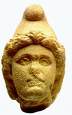
A warrior emerges from the dust

Detail of painted Roman Statue
The marble head of a warrior woman has emerged from Vesuvius' volcanic rock.

Buried by the eruption that nearly 2,000 years ago covered Pompeii and the nearby towns of Herculaneum and Stabiae with nine to 20 feet of hot ash and pumice, the painted marble bust was found in a collapsed escarpment near Herculaneum's Basilica.

Almost entirely destroyed by an earthquake 17 years before the eruption, the Basilica was rebuilt by proconsul Marcus Nonius Balbus. It was unearthed in the 18th century, when the entire town of Herculaneum was discovered by chance during the construction of a well.

The statue has coloured hair and make up, and her pupils and eyelashes look just like they did when Herculaneum was buried by the eruption.

Sunday, March 26, 2006

Delenda est Carthago

I remember having to learn this sentence at school, it demonstrated a rule in Latin, a very important rule, one which I have completely forgotten. But let's start with a quick explanation for the ones who weren't force-fed Latin grammar in their childhood.

Delenda Est Carthago, Carthage must be destroyed, or more exactly: "Ceterum censeo Carthaginem esse delendam" which translates as "And therefore, I conclude that Carthage must be destroyed", was the motto of arch-conservative Roman Senator Marcus Porcius Cato. He is generally referred to as Cato the Elder to distinguish him from his grandson of the same name, who also rose to prominence in Roman history and is known as the Younger.

Cato was relentless. He used this motto, this tagline, everywhere.

Rome had already fought two wars against Carthage, most of us are vaguely familiar with the second of these during which Hannibal crossed the Alps with his elephants. Cato, veteran of both wars, was appointed an ambassador to Carthage. He was astonished, and appalled, at what he saw there.

He saw the mighty harbour with wharves piled with the wealth of many countries; the marketplace with abundant food from many parts of the world, warehouses filled with spices, rich and rare merchandise, gold, precious oils and ivory. He saw the graceful houses with their sculpted gardens, the towering public buildings, the massive city walls; the wealth of Carthage was great and wonderful. And he was sickened.

Cato understood that two expansionist empires could not co-exist. The world would be ruled by one power or the other, Imperialist Rome with her armies or the commercial empire of the Phoenicians, and he saw but one way to ensure Rome would triumph. Rome must move fast and strike first with all her force, a pre-emptive strike, Carthage must be destroyed.

It was easy to demonise the Phoenician people as brutish, murderous barbarians. The religion was different, the language and lifestyle different, they looked different. In Carthage, people were somehow less human than those in Rome. The Romans viewed Hannibal himself in mythic terms, as a folk monster, a devourer of children, a cruel and cunning invader who was stopped only by epic courage and perseverance from the vastly morally superior people of Rome.

The only defense, Cato said, was to attack. To destroy it.

Eventually, Cato's persistence paid off, and Rome started the third and final Punic War against her trade rival.

Cato's slogan was implemented in typical thorough-going Roman style. The walls of Carthage were torn down, the city put to the torch, the citizens were sold into slavery and the Senate decreed that no one could live where Carthage once stood. Some stories say the fields were sewn with salt.

In any case, Carthage was destroyed.

Friday, February 24, 2006

Consider the Egg

As easter time approaches, it's a chance to consider the egg.

The glorious egg, with its deep links to Creation mythology, is one of the oldest symbols of life and rebirth known to us. Many gods, demons and heroes have sprung from eggs. It's a symbol of new life in cultures as far apart as Polynesian, Chinese, Phoenician, Egyptian and Greek and represents resurrection in Christian belief.

Hindu mythology brings us a vivid picture of how the world-egg became the world we now live in. There was one, a warm, glowing, single egg. It rocked gently, a crack appeared, and the world was born. Half the shell became the earth and the other half became the sky. Mountains were created from the inner membrane and clouds from the outer. The veins formed rivers, the fluid became the ocean and the yolk formed the sun. It makes a kind of sense when you consider the egg.

Portrayals of winged eggs commonly float above Egyptian mummies, carrying the soul to another birth. A great bird, Tien, dropped an egg in China and a man emerged from it. Another egg of note is that of the phoenix, the bird which dies in flames every 14,000 years after setting its own nest alight. From the resulting ashes, a new egg emerges from which hatches a new phoenix, which dies in flames ... and so it goes.

Thursday, February 16, 2006

Venus and the Female Body

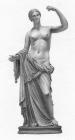
She was born out of the sea, a child of the sky god and the fertile sea womb, arising fully mature from the primordial waters. She surged from the foam, stepping delicately onto a floating seashell, and the wind of the west blew her softly to Cyprus.

She was originally known for her amorous nature, and associated with the arrival of Spring, as the bringer of joy for gods and mortals alike.

Venus and the Romans : The people of Rome had a special love for Venus. She is the mother of Aeneas, the Trojan hero who carried his father Anchises on his back from the ruins of Troy, and, after many adventures and tribulations, arrived in Italy to found the great city of Rome.

The dictator Sulla made her patron of Rome, and both Julius Caesar and the emperor Augustus named her the ancestor of their (Julian) family: the 'gens Julia'. Full of the Roman virtue of gravitas, Caesar introduced the cult of Venus Genetrix, the goddess of motherhood and marriage. She was portrayed no longer as amorous and sensual but matronly and chaste.

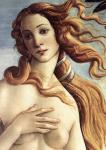
Venus as archetype : Society reflects its idealised women by archetypal images of femininity and sexuality. The rise of Christianity celebrated a sweet and vulnerable womanhood, seen particularly clearly in the image by Botticelli of the young gentle maiden. You can't fail to notice, however, that she has breasts.

Earlier cultures recognised the domain of emotion, passion and creativity as one with intense and volatile attributes of fecundity and fruitfulness. They gave us a sensual Venus with a proudly swollen belly, with prominent thighs and buttocks.

My renter, In the Outer, informs us an altercation has arisen " .. about the cover of the recent issue of Leadership which features a statue depicting in clear view some fine "marble bosom". Rather than discuss the import of what the issue was dedicated to, it appears that readers are more concerned with the supposed propriety of depicting a statue with bare breasts on the cover page of a magazine dedicated to ministers and ministry.".

You'll have to read the rest of his post, it will certainly make you wonder about people who have problems with a marble statue depicting the beauty of the female body.

I do indeed hope they are never subjected to a real live one.

Wednesday, February 15, 2006

Judas

Judas : What was he on about?

The Passover Plot : Special 40th Anniversary Edition : Hugh J Schonfield Theologian Schonfield argued that the crucifixion of Christ was a conscious re-enactment of Biblical prophecy and Judas acted with Jesus' full knowledge and consent in "betraying" his master to the authorities.

The act of Judas has been much discussed in context of free will, I spent hours in my younger days thinking about the whole betrayal business. The mainstream position has been that although Jesus knew that Judas would betray him, Judas was still acting in free will and was culpable for his actions. There's certainly some contradiction here in the idea of "the betrayal of God". The possibilities seem to be these:

* Jesus did not foresee the betrayal by Judas.
* He was unable to prevent it.
* He allowed Judas to betray him.
* Judas was an informed accomplice in Jesus' planned destiny.

My Renter, In the Outer, looks at a new discussion on Was Judas Misunderstood?

Monday, February 13, 2006

Paccariscas of Peru

The Paccarisca was usually saluted with the cry, "Thou art my birthplace, thou art my life-spring. Guard me from evil, O Paccarisca!"

An Oracle Spirit was present near these holy stones so the paccariscas were treated with great reverence and people were loth to stray too far from them.

Worship of stones is common no matter where you are in the world. The rocks are the very bones of the earth and hold the mysteries of creation, of unimaginable time and the space between the stars. Many Native American creation myths place humans as coming forth from the womb of the great terrestrial mother. From earliest times people everywhere have sought refuge in caves, lived in them and raised their children, rejoiced around the fire and learnt the subtlety of the human psyche.

Paccariscas are found at Callca, in the valley of the Yucay, and at Titicaca there is a great mass of red sandstone on the top of a high ridge with almost inaccessible slopes and dark, gloomy recesses where the sun took refuge in the time of the great flood. The rock of Titicaca is the Paccarisca of the great Sun himself.

Tuesday, February 07, 2006

Love is in the air ... again

It's that time of year again, when chocolates and flowers start doing the rounds and Valentine cards with messages of undying love appear, like mushrooms, overnight.

Have you noticed the mythological allusions in the greeting cards? You can't miss Eros with his tiny arrows, or Cupid as he is more commonly termed to avoid any indelicate reference to biological urges. Tales of legendary lovers abound, Lancelot and Guinevere, Tristan and Isolde, or Hero and Leander. Even Romeo and Juliet get a re-run. But are these loving couples really good role models for a succesful relationship?

Take the young lover theme for example. The original pair were Pyramus and Thisbe, teenagers from opposing families in Ancient Babylon who fell in love, mixed up some messages to each other and ended up dead. Not a very inspiring story to start with, although Shakespeare improved on the material and West Side Story certainly sold a lot of tickets. But overall, it's a most unsatisfactory conclusion.

Then there's the couple kept apart by honour. The story of Tristan and Isolde, like that of Lancelot and Gionevere, is often held up as an example of true and perfect love. All the ingredients for a satisfactory narrative are present; the lightning bolt of desire, the inevitable tragedy, ritual sacrifice, the denial of satisfaction and the purity of renunciation. These days, the path of honourable chastity has lost popularity.

But what else can you expect from the barbed darts of the spiteful Eros? Even Apollo wasn't immune.

While swaggering round one morning the Sun God came across Eros sharpening his darts and, full of his own importance, disparaged the puny weapons. One of these arrows which Eros honed so carefully was to instantly cause infatuation, the other to repel it. The former was of gold and sharp-pointed, the latter blunt and tipped with lead. Full of malice, Eros took up the leaden shaft and struck the nymph Daphne, and with the golden one, he shot the cocky Apollo right through the heart.

Poor Daphne, who wished only to remain unmarried and alone in the deep woods, was immediately pursued by the lustful Apollo. Bent on rape, he chased her relentlessly through the woods. The desperate nympth, finally overcome with exhaustion, turned into a laurel tree. You must admit that while the story may be interesting for mythological reasons, it's not much of a yarn.

Eros even wounded his own mother Venus in the bosom with one of his arrows. Before the wound healed she beheld Adonis, and that was that! Utterly captivated, she left her pleasant garden, and followed the youth through the woods and over the hills and far away. Not the kind of behaviour to be encouraged in mothers at the best of times.

And then there's Zeus. Any love story involving Zeus is essentially a contradiction in itself, the Great Philanderer was at best an overbearing boasting Casanova or at worst, an arch-rapist, that is, until he met Ganymede.

In earlier days, all Greeks were familiar with the tales that told of the many affairs of Zeus, of the ill-fated love of Apollo and Hyacinth, of Achilles and Patroclus, and of many other such passionate friendships between gods or heroes and handsome youths. These stories are not so popular today and many in these modern times have forgotten Ganymede, the most beautiful boy in the world, but in any case, apart from the youth suffering an untimely death, his story isn't universally suitable for a Valentines Day greeting card message.

Perhaps the best Valentine's Day greeting is a simple kiss, a hug, and three little words. It's kept the world going around for a while now.

I've put together a list of Real Love Legends on the main website at All Info About Myths & Legends and don't forget, you can get the Legends and Lore eZine free every fortnight
Friday, February 03, 2006

Brighid, Queen of Heaven

In the Northern Hemisphere Imbolc is still celebrated. Take my renter for example, Fading the Surface Noise, she will be building a bonfire with '.. old Christmas trees, symbolizing the spark of new growth & creative inspiration.' And honouring Brighid

Brighid is the most powerful religious figure in all of Irish history. She has moved through the ages with scarcely a change and travelled effortlessly down the centuries. Over hundreds of generations Brighid moves with grace and power, fulfilling different roles in different times.

The Irish say that Brighid gave us whistling, that she invented this one night when she wanted to call her friends. And that she taught us how to keen the mournful song of the bereaved woman. This keening links Brighid to the great mother goddesses of the eastern Mediterranean, and like them, she was identified with fertility of the soil, and with the earth itself.

More on Brighid, Queen of Heaven

Thursday, February 02, 2006

Lupercalia


Lupercalia was a Roman ritual of purification and fertility dating from such an ancient time that even the Romans of the first century Common Era had totally forgotten what it was all about.

On February 14, the Luperci, young men who were naked except for the skins of goats they had just sacrificed, ran from the Lupercal around the bounds of the Palatine, both to purify that ancient site in a ceremony of lustration (lustratio) and, striking the women they met with strips of goat skin, to promote fertility.

These days we prefer flowers and chocolate


The Irish called this month Feabhra or an Gearran, the gelding or horse. The horse was used to draw the plough, but Gearran also means 'to cut' and 'Gearran' can be used to describe the 'cutting' Spring winds. To the Anglo-Saxons, this was Solmonath, "sun month," in honor of the gradual return of the light after the darkness of winter. According to Asatru traditions, this month is Horning, from horn, the turn of the year.