As easter time approaches, it's a chance to consider the egg.
The glorious egg, with its deep links to Creation mythology, is one of the oldest symbols of life and rebirth known to us. Many gods, demons and heroes have sprung from eggs. It's a symbol of new life in cultures as far apart as Polynesian, Chinese, Phoenician, Egyptian and Greek and represents resurrection in Christian belief.
Hindu mythology brings us a vivid picture of how the world-egg became the world we now live in. There was one, a warm, glowing, single egg. It rocked gently, a crack appeared, and the world was born. Half the shell became the earth and the other half became the sky. Mountains were created from the inner membrane and clouds from the outer. The veins formed rivers, the fluid became the ocean and the yolk formed the sun. It makes a kind of sense when you consider the egg.
Portrayals of winged eggs commonly float above Egyptian mummies, carrying the soul to another birth. A great bird, Tien, dropped an egg in China and a man emerged from it. Another egg of note is that of the phoenix, the bird which dies in flames every 14,000 years after setting its own nest alight. From the resulting ashes, a new egg emerges from which hatches a new phoenix, which dies in flames ... and so it goes.
Friday, February 24, 2006


Thursday, February 16, 2006
Venus and the Female Body
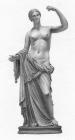 She was born out of the sea, a child of the sky god and the fertile sea womb, arising fully mature from the primordial waters. She surged from the foam, stepping delicately onto a floating seashell, and the wind of the west blew her softly to Cyprus.
She was originally known for her amorous nature, and associated with the arrival of Spring, as the bringer of joy for gods and mortals alike.
Venus and the Romans : The people of Rome had a special love for Venus. She is the mother of Aeneas, the Trojan hero who carried his father Anchises on his back from the ruins of Troy, and, after many adventures and tribulations, arrived in Italy to found the great city of Rome.
The dictator Sulla made her patron of Rome, and both Julius Caesar and the emperor Augustus named her the ancestor of their (Julian) family: the 'gens Julia'. Full of the Roman virtue of gravitas, Caesar introduced the cult of Venus Genetrix, the goddess of motherhood and marriage. She was portrayed no longer as amorous and sensual but matronly and chaste.
 Venus as archetype : Society reflects its idealised women by archetypal images of femininity and sexuality. The rise of Christianity celebrated a sweet and vulnerable womanhood, seen particularly clearly in the image by Botticelli of the young gentle maiden. You can't fail to notice, however, that she has breasts.
Earlier cultures recognised the domain of emotion, passion and creativity as one with intense and volatile attributes of fecundity and fruitfulness. They gave us a sensual Venus with a proudly swollen belly, with prominent thighs and buttocks.
My renter, In the Outer, informs us an altercation has arisen " .. about the cover of the recent issue of Leadership which features a statue depicting in clear view some fine "marble bosom". Rather than discuss the import of what the issue was dedicated to, it appears that readers are more concerned with the supposed propriety of depicting a statue with bare breasts on the cover page of a magazine dedicated to ministers and ministry.".
You'll have to read the rest of his post, it will certainly make you wonder about people who have problems with a marble statue depicting the beauty of the female body.
I do indeed hope they are never subjected to a real live one.
Wednesday, February 15, 2006
Judas
 Judas : What was he on about?
 The Passover Plot : Special 40th Anniversary Edition : Hugh J Schonfield Theologian Schonfield argued that the crucifixion of Christ was a conscious re-enactment of Biblical prophecy and Judas acted with Jesus' full knowledge and consent in "betraying" his master to the authorities.
The act of Judas has been much discussed in context of free will, I spent hours in my younger days thinking about the whole betrayal business. The mainstream position has been that although Jesus knew that Judas would betray him, Judas was still acting in free will and was culpable for his actions. There's certainly some contradiction here in the idea of "the betrayal of God". The possibilities seem to be these:
* Jesus did not foresee the betrayal by Judas.
* He was unable to prevent it.
* He allowed Judas to betray him.
* Judas was an informed accomplice in Jesus' planned destiny.
My Renter, In the Outer, looks at a new discussion on Was Judas Misunderstood?
Monday, February 13, 2006
Paccariscas of Peru
 The Paccarisca was usually saluted with the cry, "Thou art my birthplace, thou art my life-spring. Guard me from evil, O Paccarisca!"
 An Oracle Spirit was present near these holy stones so the paccariscas were treated with great reverence and people were loth to stray too far from them.
Worship of stones is common no matter where you are in the world. The rocks are the very bones of the earth and hold the mysteries of creation, of unimaginable time and the space between the stars. Many Native American creation myths place humans as coming forth from the womb of the great terrestrial mother. From earliest times people everywhere have sought refuge in caves, lived in them and raised their children, rejoiced around the fire and learnt the subtlety of the human psyche.
Paccariscas are found at Callca, in the valley of the Yucay, and at Titicaca there is a great mass of red sandstone on the top of a high ridge with almost inaccessible slopes and dark, gloomy recesses where the sun took refuge in the time of the great flood. The rock of Titicaca is the Paccarisca of the great Sun himself.
Tuesday, February 07, 2006
Love is in the air ... again
It's that time of year again, when chocolates and flowers start doing the rounds and Valentine cards with messages of undying love appear, like mushrooms, overnight.
Have you noticed the mythological allusions in the greeting cards? You can't miss Eros with his tiny arrows, or Cupid as he is more commonly termed to avoid any indelicate reference to biological urges. Tales of legendary lovers abound, Lancelot and Guinevere, Tristan and Isolde, or Hero and Leander. Even Romeo and Juliet get a re-run. But are these loving couples really good role models for a succesful relationship?
Take the young lover theme for example. The original pair were Pyramus and Thisbe, teenagers from opposing families in Ancient Babylon who fell in love, mixed up some messages to each other and ended up dead. Not a very inspiring story to start with, although Shakespeare improved on the material and West Side Story certainly sold a lot of tickets. But overall, it's a most unsatisfactory conclusion.
Then there's the couple kept apart by honour. The story of Tristan and Isolde, like that of Lancelot and Gionevere, is often held up as an example of true and perfect love. All the ingredients for a satisfactory narrative are present; the lightning bolt of desire, the inevitable tragedy, ritual sacrifice, the denial of satisfaction and the purity of renunciation. These days, the path of honourable chastity has lost popularity.
But what else can you expect from the barbed darts of the spiteful Eros? Even Apollo wasn't immune.
While swaggering round one morning the Sun God came across Eros sharpening his darts and, full of his own importance, disparaged the puny weapons. One of these arrows which Eros honed so carefully was to instantly cause infatuation, the other to repel it. The former was of gold and sharp-pointed, the latter blunt and tipped with lead. Full of malice, Eros took up the leaden shaft and struck the nymph Daphne, and with the golden one, he shot the cocky Apollo right through the heart.
Poor Daphne, who wished only to remain unmarried and alone in the deep woods, was immediately pursued by the lustful Apollo. Bent on rape, he chased her relentlessly through the woods. The desperate nympth, finally overcome with exhaustion, turned into a laurel tree. You must admit that while the story may be interesting for mythological reasons, it's not much of a yarn.
Eros even wounded his own mother Venus in the bosom with one of his arrows. Before the wound healed she beheld Adonis, and that was that! Utterly captivated, she left her pleasant garden, and followed the youth through the woods and over the hills and far away. Not the kind of behaviour to be encouraged in mothers at the best of times.
And then there's Zeus. Any love story involving Zeus is essentially a contradiction in itself, the Great Philanderer was at best an overbearing boasting Casanova or at worst, an arch-rapist, that is, until he met Ganymede.
In earlier days, all Greeks were familiar with the tales that told of the many affairs of Zeus, of the ill-fated love of Apollo and Hyacinth, of Achilles and Patroclus, and of many other such passionate friendships between gods or heroes and handsome youths. These stories are not so popular today and many in these modern times have forgotten Ganymede, the most beautiful boy in the world, but in any case, apart from the youth suffering an untimely death, his story isn't universally suitable for a Valentines Day greeting card message.
Perhaps the best Valentine's Day greeting is a simple kiss, a hug, and three little words. It's kept the world going around for a while now.
I've put together a list of Real Love Legends on the main website at All Info About Myths & Legends and don't forget, you can get the Legends and Lore eZine free every fortnight
Have you noticed the mythological allusions in the greeting cards? You can't miss Eros with his tiny arrows, or Cupid as he is more commonly termed to avoid any indelicate reference to biological urges. Tales of legendary lovers abound, Lancelot and Guinevere, Tristan and Isolde, or Hero and Leander. Even Romeo and Juliet get a re-run. But are these loving couples really good role models for a succesful relationship?
Take the young lover theme for example. The original pair were Pyramus and Thisbe, teenagers from opposing families in Ancient Babylon who fell in love, mixed up some messages to each other and ended up dead. Not a very inspiring story to start with, although Shakespeare improved on the material and West Side Story certainly sold a lot of tickets. But overall, it's a most unsatisfactory conclusion.
Then there's the couple kept apart by honour. The story of Tristan and Isolde, like that of Lancelot and Gionevere, is often held up as an example of true and perfect love. All the ingredients for a satisfactory narrative are present; the lightning bolt of desire, the inevitable tragedy, ritual sacrifice, the denial of satisfaction and the purity of renunciation. These days, the path of honourable chastity has lost popularity.
But what else can you expect from the barbed darts of the spiteful Eros? Even Apollo wasn't immune.
While swaggering round one morning the Sun God came across Eros sharpening his darts and, full of his own importance, disparaged the puny weapons. One of these arrows which Eros honed so carefully was to instantly cause infatuation, the other to repel it. The former was of gold and sharp-pointed, the latter blunt and tipped with lead. Full of malice, Eros took up the leaden shaft and struck the nymph Daphne, and with the golden one, he shot the cocky Apollo right through the heart.
Poor Daphne, who wished only to remain unmarried and alone in the deep woods, was immediately pursued by the lustful Apollo. Bent on rape, he chased her relentlessly through the woods. The desperate nympth, finally overcome with exhaustion, turned into a laurel tree. You must admit that while the story may be interesting for mythological reasons, it's not much of a yarn.
Eros even wounded his own mother Venus in the bosom with one of his arrows. Before the wound healed she beheld Adonis, and that was that! Utterly captivated, she left her pleasant garden, and followed the youth through the woods and over the hills and far away. Not the kind of behaviour to be encouraged in mothers at the best of times.
And then there's Zeus. Any love story involving Zeus is essentially a contradiction in itself, the Great Philanderer was at best an overbearing boasting Casanova or at worst, an arch-rapist, that is, until he met Ganymede.
In earlier days, all Greeks were familiar with the tales that told of the many affairs of Zeus, of the ill-fated love of Apollo and Hyacinth, of Achilles and Patroclus, and of many other such passionate friendships between gods or heroes and handsome youths. These stories are not so popular today and many in these modern times have forgotten Ganymede, the most beautiful boy in the world, but in any case, apart from the youth suffering an untimely death, his story isn't universally suitable for a Valentines Day greeting card message.
Perhaps the best Valentine's Day greeting is a simple kiss, a hug, and three little words. It's kept the world going around for a while now.
I've put together a list of Real Love Legends on the main website at All Info About Myths & Legends and don't forget, you can get the Legends and Lore eZine free every fortnight
Friday, February 03, 2006
Brighid, Queen of Heaven
In the Northern Hemisphere Imbolc is still celebrated. Take my renter for example, Fading the Surface Noise, she will be building a bonfire with '.. old Christmas trees, symbolizing the spark of new growth & creative inspiration.' And honouring Brighid
Brighid is the most powerful religious figure in all of Irish history. She has moved through the ages with scarcely a change and travelled effortlessly down the centuries. Over hundreds of generations Brighid moves with grace and power, fulfilling different roles in different times.
The Irish say that Brighid gave us whistling, that she invented this one night when she wanted to call her friends. And that she taught us how to keen the mournful song of the bereaved woman. This keening links Brighid to the great mother goddesses of the eastern Mediterranean, and like them, she was identified with fertility of the soil, and with the earth itself.
More on Brighid, Queen of Heaven
Brighid is the most powerful religious figure in all of Irish history. She has moved through the ages with scarcely a change and travelled effortlessly down the centuries. Over hundreds of generations Brighid moves with grace and power, fulfilling different roles in different times.
The Irish say that Brighid gave us whistling, that she invented this one night when she wanted to call her friends. And that she taught us how to keen the mournful song of the bereaved woman. This keening links Brighid to the great mother goddesses of the eastern Mediterranean, and like them, she was identified with fertility of the soil, and with the earth itself.
More on Brighid, Queen of Heaven
Thursday, February 02, 2006
Lupercalia

Lupercalia was a Roman ritual of purification and fertility dating from such an ancient time that even the Romans of the first century Common Era had totally forgotten what it was all about.
On February 14, the Luperci, young men who were naked except for the skins of goats they had just sacrificed, ran from the Lupercal around the bounds of the Palatine, both to purify that ancient site in a ceremony of lustration (lustratio) and, striking the women they met with strips of goat skin, to promote fertility.
These days we prefer flowers and chocolate
The Irish called this month Feabhra or an Gearran, the gelding or horse. The horse was used to draw the plough, but Gearran also means 'to cut' and 'Gearran' can be used to describe the 'cutting' Spring winds. To the Anglo-Saxons, this was Solmonath, "sun month," in honor of the gradual return of the light after the darkness of winter. According to Asatru traditions, this month is Horning, from horn, the turn of the year.
Tuesday, January 31, 2006
Lucky Tips
 The number 8 is a hot favorite at the moment. Just after Chinese New Year, it's a perfect choice. Even numbered days are considered lucky, the 2nd and 8th day of the New Year being the most popular, and don't forget to wear red on these days for extra luck.
Best tip of all, don't take lucky tips seriously
Sunday, January 29, 2006
Kuan Yin, Mother of Compassion
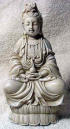 Women everywhere have prayed to her. Sometimes it is as the Tibetan Tara, sometimes as the Christian Madonna or the African Yemaya or any other of a dozen names. As Kuan Yin, Mother of Compassion, she is universally beloved.
 Kuan Yin is invoked for healing of a sick child, relief from pain and help in all times of trouble. Like Artemis, she is a virgin Goddess who protects women, offers them an alternative to marriage, and grants children to those who desire them.
Bodhisattva: She is said to be a bodhisattva, one qualified to enter Nirvana but who chooses to remain in the earthly realms and not enter the heavenly worlds until all other living things have completed their own enlightenment and liberated from the pain-filled cycle of birth, death, and rebirth. "I am cultivating this method of great compassion and hope to save all living beings," said Kuan Yin. "Any living being who calls my name or sees me will be free from all fear and danger."
read more >>>
Happy New Year!

Eleventh in the cycle, Dog Years follow the Rooster years. The Chinese name is GOU, the sign of fidelity.
.. Happy New Year...
May all your hopes, dreams and desires come to fruition in the Year of the Dog, 2006.
They say people born in the Year of the Dog are the nicest of the lot, Read more >>
Drop in and wish my tenant at Northern Bound a Happy New Year, and if you have any theories as to why we can build skyscrapers but not a simple ancient pyramid, let her know.
Friday, January 27, 2006
A Queen Unearthed
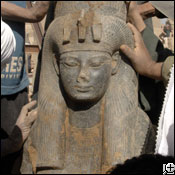
A life-size statue believed to represent Queen Tiy, the grandmother of King Tutankhamun, was just unearthed in Luxor, Egypt, according to a Johns Hopkins University press release.
Tut's grandmother was the cousin of two famous queens of ancient Egypt: Nefertiti and Hatshepsut. The statue, dated to between 1391 and 1352 B.C., reveals the family's renowned beauty.
Tiy was the daughter of Yuaa, a priest of an Egyptian fertility god, Min. He likely was a "foreigner" from Syria. Less is known about her mother, Tuaa, but it is believed that Tuaa was of royal descent, probably from the royal family of Mittani, which was a kingdom in northern Syria.
Tiy married Pharaoh Amenhotep III when she was 12 years old. Her husband, who consulted her regarding state affairs and official policies, acknowledged her intelligence and ambition.
Wednesday, January 25, 2006
Otzi's Revenge?
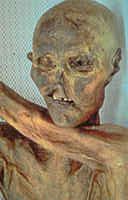 Has the Spirit of Otzi the Iceman claimed another victim? Has Frozen Fritz fingered the seventh man who disturbed his grave?
 When a naked human body was found trapped in the ice at an altitude of 10,500 feet up the Alps in 1991, he was at first thought to be a lost hiker. But Otzi is from 3300 BCE. He was a dark-complexioned man in his 40s, about 5-feet 2-inches tall, some healing fractured ribs, and arthritis. He also had a stone arrowhead embedded in his left shoulder. In addition, traces of blood from four other people have been found on his clothes and weapons, Otzi didn't die peacefully.
Otzi's Curse: And, like the Curse of the Pharoahs, there are stories of the Curse of the Iceman. Now eight deaths are attributed to the 'curse'.
One - Rainer Henn, forensic pathologist, who picked up Otzi's body, killed on his way to a conference to discuss Otzi
Two - Kurt Fritz, who uncovered the Iceman's face, accident
Three - Journalist Rainer Hoelz, who filmed the recovery of Ötzi from the ice for the ORF network, died of a brain tumor.
Four - Helmut Simon who discovered the Iceman's body, froze to death in the snow
Five - Dieter Warnecke, Simon's assistant, who died of a heart attack hours after Simon's funeral.
Six - Archeologist Konrad Spindler, leading expert on Otzi.
Seven - Molecular biologist Tom Loy who examined Otzi's DNA, died in unclear circumstances in Australia last November
Eight- Professor Friedrich Tiefenbrunner, member of Spindler's team, died during open-heart surgery earlier this month
New tenant
Not laying down in a bog, but laying down in the rent-a-blog to your right is Northern Bound, a talented writer and artist.
I may ask her the price of making me a small incense holder, I think she needs some encouragement to create some more objets d'art, drop in and share some enthusiasm.
I may ask her the price of making me a small incense holder, I think she needs some encouragement to create some more objets d'art, drop in and share some enthusiasm.
The Haraldskaer Woman
 The Haraldskaer Woman is one of the few early finds that still survive today. When they were found in the Gunnelsmose ("Gunhild's bog") on the Haraldskaer estate in Denmark in 1835, it was believed that the remains were those of the Norwegian queen Gunhild.
 According to the Jomsvikinga saga she was killed and drowned in a bog at the instigation of the Danish king Harald Blatand (Blue Tooth).
King Frederick VI had a beautiful sarcophagus carved for this alleged royal mummy, in which it was laid to rest in the church of St. Nicholas in Vejle. Not everyone was convinced that the remains derived from Queen Gunhild, and a heated controversy arose.
In 1977 those who had opposed this interpretation were, posthumously, shown to be correct. A carbon date proved that the body predated the period in which Queen Gunhilde lived by some 1,500 years.
The Haraldskaer body, however, undoubtedly owes its survival to this case of mistaken identity. It still lies in the church today. (Vejle Museum, Denmark)
Monday, January 23, 2006
Castle Campbell
 Castle Campbell: Viewed from a distance, this ancient Keep might seem to the mind of the poet,
"A palace, lifting in eternal summer
Its marble head from out a glossy bower
of leaves."
Yet a nearer acquaintance with its topography will speedily dispel this illusion. The approach to the Castle soon alters from the mild riverside way with which it begins, to the rugged and stern mountain path which terminates at the ruin.
The "bower of leaves" becomes a gloomy forest, and the "marble palace" vanishes into a grim and solitary ruin, frowning defiantly from the summit of a precipice, apparently inaccessible. The road is now narrowed to an extreme limit, and crosses the fearful chasm which partly surrounds the Castle by one of those shaky wooden bridges which terrify the soul of the timourous tourist.
The two streams, which flow around the Castle and fall into the Devon, have been named by some romantic twit in Victorian times, the Water of Care and the Burn of Greif (Gryfe). The ancient title of the ruin itself was said to be "the Castle of Gloom," and the site of the melancholy trio was "the Valley of Dolour."
This poetical combination, however, is just fanciful nonsense. Sad, but true. The name of Castle Gloom is a corruption of the Gaelic Chleum or Loch Leum, the Leap. The Water of Care is an easy transition from Caer, the prefix for a castle and its surroundings. Dollar is originally Balor, the high field.
Tradition says Castle Campbell was a portion of the dowry which Robert the Bruce bestowed upon his sister, Lady Mary Bruce, on her marriage to Neil Campbell of Lochow
Saturday, January 21, 2006
The Chocolate Pope
 David Wolfe says his love of cacao led him to create a chocolate religion. "I nominated myself the Chocolate Pope," he says. "The only two requirements for joining the chocolate religion are you have to love cacao and you have to help us get a "Charlie and the Chocolate Factory" book into every hotel room in the world, because that is the chocolate Bible."
Before you run away shrieking, this a true story.
An eagle-eyed reader, AchadaMaia, spotted it in belief.net. This Wolfe isn't a total nut. He's a raw food expert with degrees in mechanical and environmental engineering and political science. While trying to decide what to do with his life, he earned a law degree from the University of San Diego and became a minister in the Essene Church of Christ, a denomination which says it aims to restore Jesus' teachings on vegetarianism, reincarnation, and the feminine aspect of God. The Essene Church of Christ believes that these teachings were removed from the original New Testament.
But since eating his first fresh cacao bean--the natural form of chocolate-- in Hawaii, Wolfe has left his post at the pulpit and instead devoted his life to preaching the good word--about chocolate.
But let's leave the Chocolate Pope for a moment,
Is Chocolate good for you?
Neolithic Orkney
 In the centre of West-Mainland Orkney, covered by a thick layer of turf and grass is Maeshowe Chambered Tomb, one of the major monuments of the UNESCO World Heritage Site known as The Heart of Neolithic Orkney.
Inside the tomb is the biggest collection of Viking runes ever found in situ.
Most of the 23 inscriptions simply show a name followed by the "RR" for "reist runa" which tells us who carved the runes. But the inscriptions also tell us that those who carved the runes were well educated, and knew the classical futhork-alphabet with its 24 runes as well as the Anglo-Saxon variation with 33 different letters.
Written in tree or twig-runes is praise for Ingibiorg, the most beautiful woman in the world, accordng to Erlingr one of her admirers.
Thorhall Asgrimsson carved his runes with an axe that his great-great-great grandfather used to kill Gauk Trandilsson, a Viking from Ireland. Thorhall also mentions he was the Skipper of the Norwegian longship that brought Earl Rongvald from Bergen to Orkney on his return from the Holy Crusade.
For the best resource, see Neolithic Orkney maintained by Sigurd Towrie who incidentally is a look-alike clone of my nephew, Craig Murray of Hobart.
Friday, January 20, 2006
Secrets of the Irish Bog Men
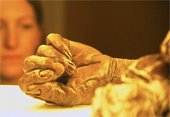 The remains of two men preserved in the peat bogs of central Ireland were unveiled this month in Dublin. Peat wetlands in northwest Europe are well-known for their bog bodies, the cold, acidic, oxygen-free conditions preventing decay and mummifying human flesh.
One bog body, named Oldcroghan Man, was preserved so perfectly that his discovery sparked a police murder investigation before archaeologists were called in. Living well over 2,000 years ago, he was in his early 20s, and stood 6 feet 6 inches (198 centimeters) tall. You can still see his fingerprint whorls.
"He had very well manicured nails, and his fingertips and hands were indicative of somebody who didn't carry out any manual labour," says said Isabella Mulhall, the museum's Bog Bodies Project coordinator. "So we presume he came from the upper echelons of society. He had no scars on his body either, just the equivalent of two small paper cuts to one of his hands".
National Geographic News
Thursday, January 19, 2006
Games of the Gods
 The Olympic Games, originally created to honour Zeus, were important national festivals of the ancient Greeks. Traditions and ideals laid down in these early Games, like the truly remarkable and effective Olympic Truce, still inspire us today. But the origins of the Games, mythologically speaking, are rooted in violence, deceit and death.
In an effort to redefine the Olympics and restore some of the forgotten ideals which inspired the games of ancient Greece, a revival of an ancient tradition has been proposed, the Olympic Truce, when warring peoples laid down their arms and sought the paths of peace for the duration of the Games. Call me a spoilsport if you will, but the origin of the Olympic Games is not the best example of brotherly love and peace on earth to men of good will.
It all began with the dysfunctional family of Tantalus. We can't blame him for his great-grandson Agamemnon being murdered by another great-grandson, Aegisthus, who was in turn killed by a great-great-grandson, Orestes, nor can we hold him to account for the fate of his daughter, Niobe, who lost all her children and was turned to stone. But it was Tantalus, king at Mount Sipylus in Anatolia, who was solely and totally responsible for murdering, and cooking, his own son, Pelops.
It's an appalling story, for those whose stomachs are strong, continue reading Games of the Gods, the Origin of the Olympic Games
Wednesday, January 18, 2006
Last Charge of the Brave Heart

Dinna fear ye, Dinna fret ye
Black Douglas will no' get ye
Black Douglas: Sir James Douglas was known as the Black Douglas because of the terror his name aroused in the English. It was his task, in the end, of taking the Bruce heart, encased in a small casket made of silver, to Palestine.
The Bruce; History is strewn with warrior kings, born into times of upheaval, unrest and rebellion, their entire lives spent in battle mode. Robert the Bruce was one of these. When he died in 1329 of a virulent form of psoriasis, he left explicit instructions that his heart be taken to the Holy Land.
So off sailed the Black Douglas for Jerusalem bearing the heart of The Bruce.On the way to the Holy Land he ran into a spot of bother, arriving in Spain just as Alfonso XI of Castile was preparing to do battle against Osmyn, the Moorish governor of Grenada.
On March 25th, at Tebas de Ardales the forces of Islam and Christianity clashed. The Scots found themselves surrounded by Moorish cavalry and attempted to break through.
The Last Charge: Sensing impending defeat, Douglas led a last desperate charge. Rising on his stirrups he ripped the casket from the chain round his belt and, taking aim, hurled the heart into the melee, then charging after it.
The following day, when the main Spanish forces reached the site, the bodies of the Scottish crusaders were discovered on the battlefield. When the corpse of the Black Douglas was turned face up, the casket was found beneath his body, the heart still inside.
Robert the Bruce had lead his final charge.
Subscribe to:
Posts (Atom)
