Tuesday, January 31, 2006

Lucky Tips

The number 8 is a hot favorite at the moment. Just after Chinese New Year, it's a perfect choice. Even numbered days are considered lucky, the 2nd and 8th day of the New Year being the most popular, and don't forget to wear red on these days for extra luck.

Best tip of all, don't take lucky tips seriously

Sunday, January 29, 2006

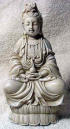
Kuan Yin, Mother of Compassion

Women everywhere have prayed to her. Sometimes it is as the Tibetan Tara, sometimes as the Christian Madonna or the African Yemaya or any other of a dozen names. As Kuan Yin, Mother of Compassion, she is universally beloved.

Kuan Yin is invoked for healing of a sick child, relief from pain and help in all times of trouble. Like Artemis, she is a virgin Goddess who protects women, offers them an alternative to marriage, and grants children to those who desire them.

Bodhisattva: She is said to be a bodhisattva, one qualified to enter Nirvana but who chooses to remain in the earthly realms and not enter the heavenly worlds until all other living things have completed their own enlightenment and liberated from the pain-filled cycle of birth, death, and rebirth. "I am cultivating this method of great compassion and hope to save all living beings," said Kuan Yin. "Any living being who calls my name or sees me will be free from all fear and danger."

read more >>>

Happy New Year!


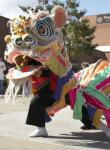
Eleventh in the cycle, Dog Years follow the Rooster years. The Chinese name is GOU, the sign of fidelity.

.. Happy New Year...

May all your hopes, dreams and desires come to fruition in the Year of the Dog, 2006.

And remember, all dogs go to heaven.
They say people born in the Year of the Dog are the nicest of the lot, Read more >>

Drop in and wish my tenant at Northern Bound a Happy New Year, and if you have any theories as to why we can build skyscrapers but not a simple ancient pyramid, let her know.

Friday, January 27, 2006

A Queen Unearthed


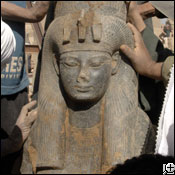
A life-size statue believed to represent Queen Tiy, the grandmother of King Tutankhamun, was just unearthed in Luxor, Egypt, according to a Johns Hopkins University press release.

Tut's grandmother was the cousin of two famous queens of ancient Egypt: Nefertiti and Hatshepsut. The statue, dated to between 1391 and 1352 B.C., reveals the family's renowned beauty.

Tiy was the daughter of Yuaa, a priest of an Egyptian fertility god, Min. He likely was a "foreigner" from Syria. Less is known about her mother, Tuaa, but it is believed that Tuaa was of royal descent, probably from the royal family of Mittani, which was a kingdom in northern Syria.

Tiy married Pharaoh Amenhotep III when she was 12 years old. Her husband, who consulted her regarding state affairs and official policies, acknowledged her intelligence and ambition.

Wednesday, January 25, 2006

Otzi's Revenge?

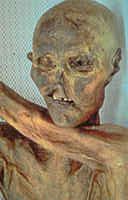
Has the Spirit of Otzi the Iceman claimed another victim? Has Frozen Fritz fingered the seventh man who disturbed his grave?

When a naked human body was found trapped in the ice at an altitude of 10,500 feet up the Alps in 1991, he was at first thought to be a lost hiker. But Otzi is from 3300 BCE. He was a dark-complexioned man in his 40s, about 5-feet 2-inches tall, some healing fractured ribs, and arthritis. He also had a stone arrowhead embedded in his left shoulder. In addition, traces of blood from four other people have been found on his clothes and weapons, Otzi didn't die peacefully.

Otzi's Curse: And, like the Curse of the Pharoahs, there are stories of the Curse of the Iceman. Now eight deaths are attributed to the 'curse'.

One - Rainer Henn, forensic pathologist, who picked up Otzi's body, killed on his way to a conference to discuss Otzi

Two - Kurt Fritz, who uncovered the Iceman's face, accident

Three - Journalist Rainer Hoelz, who filmed the recovery of Ötzi from the ice for the ORF network, died of a brain tumor.

Four - Helmut Simon who discovered the Iceman's body, froze to death in the snow

Five - Dieter Warnecke, Simon's assistant, who died of a heart attack hours after Simon's funeral.

Six - Archeologist Konrad Spindler, leading expert on Otzi.

Seven - Molecular biologist Tom Loy who examined Otzi's DNA, died in unclear circumstances in Australia last November

Eight- Professor Friedrich Tiefenbrunner, member of Spindler's team, died during open-heart surgery earlier this month

New tenant

Not laying down in a bog, but laying down in the rent-a-blog to your right is Northern Bound, a talented writer and artist.

I may ask her the price of making me a small incense holder, I think she needs some encouragement to create some more objets d'art, drop in and share some enthusiasm.

The Haraldskaer Woman

The Haraldskaer Woman is one of the few early finds that still survive today. When they were found in the Gunnelsmose ("Gunhild's bog") on the Haraldskaer estate in Denmark in 1835, it was believed that the remains were those of the Norwegian queen Gunhild.

According to the Jomsvikinga saga she was killed and drowned in a bog at the instigation of the Danish king Harald Blatand (Blue Tooth).

King Frederick VI had a beautiful sarcophagus carved for this alleged royal mummy, in which it was laid to rest in the church of St. Nicholas in Vejle. Not everyone was convinced that the remains derived from Queen Gunhild, and a heated controversy arose.

In 1977 those who had opposed this interpretation were, posthumously, shown to be correct. A carbon date proved that the body predated the period in which Queen Gunhilde lived by some 1,500 years.

The Haraldskaer body, however, undoubtedly owes its survival to this case of mistaken identity. It still lies in the church today. (Vejle Museum, Denmark)

Monday, January 23, 2006

Castle Campbell

Castle Campbell: Viewed from a distance, this ancient Keep might seem to the mind of the poet,

"A palace, lifting in eternal summer
Its marble head from out a glossy bower
of leaves."

Yet a nearer acquaintance with its topography will speedily dispel this illusion. The approach to the Castle soon alters from the mild riverside way with which it begins, to the rugged and stern mountain path which terminates at the ruin.

The "bower of leaves" becomes a gloomy forest, and the "marble palace" vanishes into a grim and solitary ruin, frowning defiantly from the summit of a precipice, apparently inaccessible. The road is now narrowed to an extreme limit, and crosses the fearful chasm which partly surrounds the Castle by one of those shaky wooden bridges which terrify the soul of the timourous tourist.

The two streams, which flow around the Castle and fall into the Devon, have been named by some romantic twit in Victorian times, the Water of Care and the Burn of Greif (Gryfe). The ancient title of the ruin itself was said to be "the Castle of Gloom," and the site of the melancholy trio was "the Valley of Dolour."

This poetical combination, however, is just fanciful nonsense. Sad, but true. The name of Castle Gloom is a corruption of the Gaelic Chleum or Loch Leum, the Leap. The Water of Care is an easy transition from Caer, the prefix for a castle and its surroundings. Dollar is originally Balor, the high field.

Tradition says Castle Campbell was a portion of the dowry which Robert the Bruce bestowed upon his sister, Lady Mary Bruce, on her marriage to Neil Campbell of Lochow

Saturday, January 21, 2006

The Chocolate Pope

David Wolfe says his love of cacao led him to create a chocolate religion. "I nominated myself the Chocolate Pope," he says. "The only two requirements for joining the chocolate religion are you have to love cacao and you have to help us get a "Charlie and the Chocolate Factory" book into every hotel room in the world, because that is the chocolate Bible."

Before you run away shrieking, this a true story.

An eagle-eyed reader, AchadaMaia, spotted it in belief.net. This Wolfe isn't a total nut. He's a raw food expert with degrees in mechanical and environmental engineering and political science. While trying to decide what to do with his life, he earned a law degree from the University of San Diego and became a minister in the Essene Church of Christ, a denomination which says it aims to restore Jesus' teachings on vegetarianism, reincarnation, and the feminine aspect of God. The Essene Church of Christ believes that these teachings were removed from the original New Testament.

But since eating his first fresh cacao bean--the natural form of chocolate-- in Hawaii, Wolfe has left his post at the pulpit and instead devoted his life to preaching the good word--about chocolate.

But let's leave the Chocolate Pope for a moment,

Is Chocolate good for you?

Neolithic Orkney

In the centre of West-Mainland Orkney, covered by a thick layer of turf and grass is Maeshowe Chambered Tomb, one of the major monuments of the UNESCO World Heritage Site known as The Heart of Neolithic Orkney.

Inside the tomb is the biggest collection of Viking runes ever found in situ.

Most of the 23 inscriptions simply show a name followed by the "RR" for "reist runa" which tells us who carved the runes. But the inscriptions also tell us that those who carved the runes were well educated, and knew the classical futhork-alphabet with its 24 runes as well as the Anglo-Saxon variation with 33 different letters.

Written in tree or twig-runes is praise for Ingibiorg, the most beautiful woman in the world, accordng to Erlingr one of her admirers.

Thorhall Asgrimsson carved his runes with an axe that his great-great-great grandfather used to kill Gauk Trandilsson, a Viking from Ireland. Thorhall also mentions he was the Skipper of the Norwegian longship that brought Earl Rongvald from Bergen to Orkney on his return from the Holy Crusade.

For the best resource, see Neolithic Orkney maintained by Sigurd Towrie who incidentally is a look-alike clone of my nephew, Craig Murray of Hobart.

Friday, January 20, 2006

Secrets of the Irish Bog Men

The remains of two men preserved in the peat bogs of central Ireland were unveiled this month in Dublin. Peat wetlands in northwest Europe are well-known for their bog bodies, the cold, acidic, oxygen-free conditions preventing decay and mummifying human flesh.

One bog body, named Oldcroghan Man, was preserved so perfectly that his discovery sparked a police murder investigation before archaeologists were called in. Living well over 2,000 years ago, he was in his early 20s, and stood 6 feet 6 inches (198 centimeters) tall. You can still see his fingerprint whorls.

"He had very well manicured nails, and his fingertips and hands were indicative of somebody who didn't carry out any manual labour," says said Isabella Mulhall, the museum's Bog Bodies Project coordinator. "So we presume he came from the upper echelons of society. He had no scars on his body either, just the equivalent of two small paper cuts to one of his hands".

National Geographic News

Thursday, January 19, 2006

Games of the Gods

The Olympic Games, originally created to honour Zeus, were important national festivals of the ancient Greeks. Traditions and ideals laid down in these early Games, like the truly remarkable and effective Olympic Truce, still inspire us today. But the origins of the Games, mythologically speaking, are rooted in violence, deceit and death.

In an effort to redefine the Olympics and restore some of the forgotten ideals which inspired the games of ancient Greece, a revival of an ancient tradition has been proposed, the Olympic Truce, when warring peoples laid down their arms and sought the paths of peace for the duration of the Games. Call me a spoilsport if you will, but the origin of the Olympic Games is not the best example of brotherly love and peace on earth to men of good will.

It all began with the dysfunctional family of Tantalus. We can't blame him for his great-grandson Agamemnon being murdered by another great-grandson, Aegisthus, who was in turn killed by a great-great-grandson, Orestes, nor can we hold him to account for the fate of his daughter, Niobe, who lost all her children and was turned to stone. But it was Tantalus, king at Mount Sipylus in Anatolia, who was solely and totally responsible for murdering, and cooking, his own son, Pelops.

It's an appalling story, for those whose stomachs are strong, continue reading Games of the Gods, the Origin of the Olympic Games

Wednesday, January 18, 2006

Last Charge of the Brave Heart


Dinna fear ye, Dinna fret ye
Black Douglas will no' get ye


Black Douglas: Sir James Douglas was known as the Black Douglas because of the terror his name aroused in the English. It was his task, in the end, of taking the Bruce heart, encased in a small casket made of silver, to Palestine.

The Bruce; History is strewn with warrior kings, born into times of upheaval, unrest and rebellion, their entire lives spent in battle mode. Robert the Bruce was one of these. When he died in 1329 of a virulent form of psoriasis, he left explicit instructions that his heart be taken to the Holy Land.

So off sailed the Black Douglas for Jerusalem bearing the heart of The Bruce.On the way to the Holy Land he ran into a spot of bother, arriving in Spain just as Alfonso XI of Castile was preparing to do battle against Osmyn, the Moorish governor of Grenada.

On March 25th, at Tebas de Ardales the forces of Islam and Christianity clashed. The Scots found themselves surrounded by Moorish cavalry and attempted to break through.

The Last Charge: Sensing impending defeat, Douglas led a last desperate charge. Rising on his stirrups he ripped the casket from the chain round his belt and, taking aim, hurled the heart into the melee, then charging after it.

The following day, when the main Spanish forces reached the site, the bodies of the Scottish crusaders were discovered on the battlefield. When the corpse of the Black Douglas was turned face up, the casket was found beneath his body, the heart still inside.

Robert the Bruce had lead his final charge.

Tuesday, January 17, 2006

Land of the Labyrinth


Crete 's mystery is extremely deep. Whoever sets foot on this island senses a mysterious force branching warmly and beneficently through his veins, senses his soul begin to grow. Nikos Kazantzakis

Ancient Crete was the crossroads linking three continents, and the cultural strands of Asia, Africa and Europe were woven here to produce a civilisation where the predominant deity was female. It lasted over 1500 years.

Arthur Evans was a middle-class Englishman and subject of Queen Victoria. While he ignorantly superimposed the English monarchical system onto Minoan society, he is admired for his intuition, his creative imagination and his profound scholarship.

It is to him that we owe the discovery of this marvellous civilisation, until his time only dimly reflected in legend. But he failed to grasp the nature of the Goddess-celebrating people who lived and worshipped here.

For Crete was the home of the Great Mother

Ariadne's Story is also part of this ancient island. To speak of Ariadne is to speak of Theseus, and of the Minotaur. Her story tells of blood and betrayal, of broken trust and cowardly abandonement on the glittering island of Crete, Land of the Labyrinth

Monday, January 16, 2006

Tristan and Isolde

A timeless tale of two lovers unknowingly drinking a magic potion and ultimately dying in one another's arms, the story of Tristan and Isolde is still told centuries after the songs and the ladies of the French Court are long, long forgotten.

The story of Tristan and Isolde is often held up as an example of true and perfect love. All the ingredients for a satisfactory narrative are present; the lightning bolt of desire, the inevitable tragedy, ritual sacrifice, the denial of satisfaction and the purity of renunciation. Essentially, we are told, this is a story with profound religious meaning.

Be that as it may, Tristan and Isolde is a ripping good yarn, a medieval Mills and Boone with enough minor characters and side plots to keep any writer of soap operas lucratively employed for a lifetime. There are all sorts of mystical reworkings and enthralling new spins on this irresistibly romantic old tale, it's been dished up to us in opera, science fantasy, romantic fiction, on stage and on the silver screen.

While you wait for the movie to reach you, read the rest of The Timeless Tale of Tristan and Isolde

Tablets of Stone

The Churches of Wales are many and beautiful. The photo is of Llangelynin Church near Rowen

The history of the Churches could be said to be a large part of the history of Wales. The two are so closely knit. The prehistoric Standing Stones, the Ancient Burial Chambers, the Hill Forts, and later the Castles and Churches of Wales. These are the remains, the bones, and also the monuments, the "tablets of stone" on which earlier people wrote.

Golf Origin Claim gets up the haggis

A Chinese researcher is challenging Scotland's proud claim to be the home of golf.

The Chinese were teeing off in 945CE, 500 years before the first Scot swung a club, Professor Ling Hong ling of Lanzhou University, claims. He says ancient records tell of a Chinese magistrate playing a game in which a ball is knocked into a hole with a stick. Ling says the game, called "hit-ball", reached Europe much later.

The Royal and Ancient Club in St Andrews had one comment "Golf originated here in Scotland!"

Sunday, January 15, 2006

Tristan and Isolde

The new film on the timeless tale of Tristan and Isolde is now showing. I have to wait until it crosses the equator before I get to see it, but I'm looking forward to another version of this old favourite.

The durability of the medieval romance says something about the human brain. Are we hard-wired for star-crossed love? That's worth a story in itself.

Year of the Dog

I was asked the other day for a quick overview of the Year of the Dog.

The date of the New Year is moving up fast, I was glad of the reminder. My year-long birthday will be over, no more endless carousing for another cycle, and for the next 12 years the Roosters will be on the wagon.

Traditional New Year is such a hectic time, it comes straight after Christmas, why not celebrate the Chinese New Year instead? February 28 is New Years Eve and I've arranged a quiet afternoon on the riverbank at the back of my house.

Why don't you drink a toast yourself to the Year of the Dog


Buy at Art.com
Morgan
$17.99
Buy
From Art.com

Fashion for Women Warriors

The Museo Nazionale in Naples houses this Attic red-figured bell-krater.

It depicts a mounted Amazon attacking two Greeks who fight on foot. The Amazon is brandishing her spear against one of the Greeks. She wears a finely patterned sleeved and trousered combination, and a turban-like cap.

Is she wearing camouflage? A fine weave? A dye pattern in spots?