Squidoo has ads on (virtually) every lens. The ads are nearly always google adsense ads but there are other ad formats
In order to prevent ‘click fraud’ - people clicking on their own ads in order to make money - Squidoo takes all of the money from these ads and dumps them into a big pot. This pot then has 5% taken for charity, then is split with 45% to Squidoo HQ and and the remaining 50% to all the lensmasters.
However, not every lens receives the same amount of money from the pot. The pile of money for lensmasters is broken down, with some lenses receiving more than others.
TIERS
Currently, there are 4 major ‘tiers’ that you lens can fall into when HQ determines payouts.
The tiers vary in payout each month depending on how much money Squidoo made.
Tiers are calculated from of the average lensrank of a lens for the entire month.
The top tier is TO 2,000 lenses, the second tier is TO 8,000 , and the third tier is TO 85,000. Then there's the rest.
The ‘moneymaker’ modules.
There are several of these for different merchants and in different formats.
By adding modules from these vendors to your lens, you have the opportunity to earn a commission anytime someone visits that vendor by clicking a link to them on your lens. If they click through your lens and make a purchase (note: what the guest purchases does not have to be what is listed on your lens) then Squidoo gets a small commission.
Squidoo takes all of the commissions they earn through these programs and creates a bunch of little pots, one for each lensmaster. These pots then give 5% to charity and HQ takes 45% and the remaining 50% is yours
Payout Timing - If you start using squidoo in March, the first time you will receive a payment from Squidoo is in May, due to the lag time in the system. Squidoo can’t pay out money that it hasn’t yet received.
Dashboard Earnings - The earnings on your dashboard only reflect money from money maker modules, not your adsense share.
Monday, March 01, 2010


Wednesday, July 25, 2007
Ice Age little Wonder

A Russian hunter traipsing through the remote Arctic Yamalo-Nenetsk region in May noticed what he thought was a reindeer carcass sticking out of the damp snow.
On closer inspection, the "reindeer" turned out to be a lovely little 40,000-year-old baby mammoth, perfectly encased in ice.
The six-month-old female mammoth, at 110 pounds (50 kilograms) and 51 inches long (130 centimeters long), is the size of a large dog. Scientists hope that "Lyuba" will reveal some of the genetic secrets of the prehistoric giants, and new DNA technologies have already caused discussion about resurrecting her.
The Ice Age toddler will end up on display in the Arctic town of Salekhard.
Will the prehistoric boat make it?
 This is the Abora III, a 41-foot boat made of reeds and wooden planks, on its way to Spain from NewYork. The ship's mission is to prove that early American and Mediterranean civilizations crossed the Atlantic long before Christopher Columbus did in 1492.
 The reed ship was created by the Aymara Indians of Bolivia, a 2,000 year-old Andean culture that sails in boats similar to those used by ancient Egyptians.
The Captain of the boat, Dominque Gorlitz, believes trade between continents began as early as 14,000 years ago, so he's set sail across the North Atlantic to prove that trans-Atlantic voyages in both directions were possible long before the advanced civilizations in the Mediterranean Sea.
Monday, October 30, 2006
Wonders of the Ancient World
 Image : Maussollos, the Satrap of Caria.
Only one of the ancient wonders of the world still survives - the Pyramids of Khofu, but votes are being taken for new wonders which we can still see today.
Can you name the Seven Wonders of the Ancient World off the top of your head? Just to refresh your memory ....
The Great Pyramid of Giza - A gigantic stone structure near the ancient city of Memphis, serving as a tomb for the Egyptian Pharaoh Khufu. (Cheops)
The Hanging Gardens of Babylon - A palace on the banks of the Euphrates river for King Nebuchadnezzar II. The beautiful remains of the beginning of western civilisation have all been obliterated from the ancient land of Mesopotamia. Some treasures have been destroyed, not by time and natural decay, but by massive bombings in only the last few years.
The Statue of Zeus at Olympia - An enormous statue of the Greek father of Gods, carved by the great sculptor Pheidias.
The Temple of Artemis at Ephesus - A beautiful temple in Asia Minor erected in honor of the Greek Goddess, Protector of young women and of wild nature.
The Mausoleum at Halicarnassus - A tomb constructed for King Maussollos, Persian satrap of Caria.
The Colossus of Rhodes - A colossus of Helios, God of the Sun, erected by the Greeks near the harbour of Rhodes.
The Lighthouse of Alexandria - A lighthouse built by the Ptolemies on the island of Pharos.
You can now Vote for the New Seven Wonders of the Ancient World. Or at least, vote for six of them. You may choose places such as Stonehenge, Easter Island and more. Even the Kremlin is on the list.
Sunday, October 15, 2006
Superficial aspects
 This chalk on the footpath sketch is flat. The artist is Julian Beever who gives to his drawings an amazing 3D illusion.
It's easy to be deceived. Muralist, William Cochran, says ...
"How easily paint can fool the eye is a metaphor for how easily we're fooled by surface differences in each other, like race, attitude, language, and gender. These lock us into stereotypes of who it is OK to connect with.
What could be more amazing than the fact that we are divided by illusions every day, by superficial aspects of each other that fool us into thinking we are fundamentally different, when in fact we are all fundamentally the same."
We are all fundamentally the same.
More amazing art from Julian Beever
Sunday, October 08, 2006
Mithras
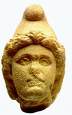 The cult of Mithras was popular throughout the Roman world from the Middle East, via Italy, to its northern limits at Hadrian’s Wall and along the German border. At least until Constantine decided that Christianity would suit his rule better.
In essence, Mithraism was centred on the worship of the saviour god Mithras, born of a Virgin and a God, whose birthday is 25 December. Sound familiar?
Because of political aspirations, and a desire to confine the power of the Army, the state religion was named as the new cult of Christianity.
More on Mithras, God of Soldiers
Thursday, September 28, 2006
Paranormal survey
Monash University, in Melbourne, Australia is conducting an online survey of the paranormal.
Whether you believe in the paranormal or not, take a few minutes to complete this survey designed to help shed light on what types of experiences people are having (or not having as the case may be).
By paranormal the survey means experiences that cannot be explained using the current laws of science. These events include premonitions, out-of-body and near-death episodes, telepathy and apparitions. Many people believe in the paranormal but this survey is not about beliefs. It is about what people ARE and are NOT experiencing. The survey is open to anyone 18 years of age or older, regardless of whether they have or have not experienced the paranormal. The survey is anonymous and will take only 5 to 10 minutes to complete.
Survey Link
Whether you believe in the paranormal or not, take a few minutes to complete this survey designed to help shed light on what types of experiences people are having (or not having as the case may be).
By paranormal the survey means experiences that cannot be explained using the current laws of science. These events include premonitions, out-of-body and near-death episodes, telepathy and apparitions. Many people believe in the paranormal but this survey is not about beliefs. It is about what people ARE and are NOT experiencing. The survey is open to anyone 18 years of age or older, regardless of whether they have or have not experienced the paranormal. The survey is anonymous and will take only 5 to 10 minutes to complete.
Survey Link
Tuesday, September 26, 2006
The lunar effect

Does a full moon make you feel like partying? Do you feel more energetic during a waxing moon? Either way, Making plans around the phases of the moon can lead to many things, from good business deals to more lustrous hair.
Roch Voller, who works in the psychiatric emergency department of Melbourne's St Vincent's Hospital, understands first-hand the meaning of the term "the lunar effect". He always expects more patient aggression when it's a full moon.
Voller isn't alone in believing in the lunar effect.
A 1987 study by the Journal Of Emergency Medicine found that 92 per cent of nurses found full moon shifts more stressful and believed they should be paid more to work on those nights.
It seems it's not just those prone to lunacy who are affected.
Shareholders are also influenced. A 2005 study by the Journal Of Empirical Finance found stock returns were consistently three to five per cent lower around the full moon than on the days around a new moon.
news.com.au
Monday, September 25, 2006
Bollywood portrays baby Krishna

Bollywood too has been contributing to the wider knowledge of mythology. After the phenomenal success of 'Hanuman' last year, Hindi film world would again witness one of the greatest heroes of all times, Krishna, an richly animated musical, aimed at children.
It's always entertaining to hear the stories of Krishna again. This becomes especially exciting when it is presented in an animation format, with Krishna in his childhood.
'KRISHNA', tells the story of Lord Krishna's birth, his childhood spent in Vrindavan and his slaying of Kansa, the evil ruler of Mathura. The film features various adventures of his childhood, including his clashes with demons like Pootna, Trinavarat and many more. This animated feature also brings to life Lord Krishna's naughty aspects like stealing butter, and other adventures.
Kannum vittum, onam unnanum
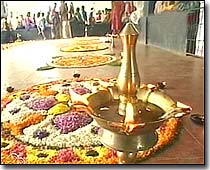 The Onam festival traces its way back to Hindu mythology and the fifth avatar of Lord Vishnu. It is a festival of colours, flowers and celebration as King Mahabali is welcomed back home.
The Vamanamoorthy temple (photo) in Kerala, is believed to be the very location where Asura king Mahabali offered his head to MahaVishnu's Vamana avatar to place the third feet of land that the noble king granted the brahmin boy.
Ceremonial celebrations at the temple go on for 10 days coinciding with the Onam festival.
On the ninth day of Uthiradam and the tenth day of Thiruvonam, the caparisoned elephants at the temple are taken in a procession to the music of Panchiratalam - the five instruments played by about 60 artisans.
The Pookkalam or flower carpets are the very soul of the Onam festival.
Arrangements are made in every home to welcome not just King Mahabali but also the peace, prosperity and happiness that he symbolises.
Mythology in the sand
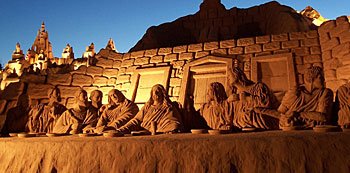 The beautiful reproduction of the Last Supper is made of sand, just one of the exhibits in the International Sand Sculpture Festival (FIESA) 2006.
The sculptures were constructed in two months by 40 sculptors, all with a mythological theme. Scenes of Greek, Celtic, Scandinavian, Assyrian, Indiana, Egyptian and African mythologies were displayed to the public during four months.
FIESA is a mega-exposition of sand sculptures made by internationally recognized sculptors in an exhibition area of 15,000 square metres with sculptures up to 15 metres in height. This year 35,000 tons of sand were been used to create theme of “Mythologies”.
Black cats and luck
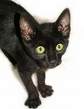 There are many tales of shape-shifting black cats in communication with the Devil in European folk-belief. But black cats have a positive image as well. Charles I owned a black cat. Although we usually associate spaniels with the English king, he looked upon his cat as great good luck and lived in fear of harm befalling his little companion.
 The day after the black cat died, Charles was siezed.
There are many cat charms relating to ships and the sea. Fishermen's wives would keep a black cat at home to prevent disaster at sea, these cats became very valuable and were often stolen. For good luck, cats were kept on board ships. If a sailor were approached by the ship's cat it meant good luck, but if the cat only came halfway and went away again it meant bad luck.
The very worst thing to happen, guaranteed to raise a storm and bring bad luck to everyone, was to throw the cat overboard.
More on Animals in Mythology
The Bat and Death

Being associated with death means being associated with rebirth. The appearance of a bat signifies the need for transformations, for letting go of old habits or ways of life and adopting new ones. Bat shows how change is necessary although it can be painful to let go of the past. As an animal of night and the dark it can also guide people through the darkness of confusion and help them face their fears.
The Bat means the opportunity for change and transformation, a coming out of the dark and being reborn. When you meet a bat, welcome him as the Blessed Bringer of Change.
More on Bats in Mythology
Celebrant versus Celibate
I had a strange reaction from a clerk in the post office who was bemused when I dropped in to pick up a parcel sent to me. It was a biggish box, and the address had Reverend clearly written in front of my name.
Clerk : I didn't know you were a priest.
Me : A minister, yes. But chiefly I'm a Funeral Celebrant.
Clerk : A celebrant? I thought you had children.
Clerk : I didn't know you were a priest.
Me : A minister, yes. But chiefly I'm a Funeral Celebrant.
Clerk : A celebrant? I thought you had children.
Time flies
Time flies. It certainly does.
I've spent the last four months doing a Funeral Director's course, which is quite different from the grief counselling. But all tied in with my celebrancy.
Back to the blog .............
I've spent the last four months doing a Funeral Director's course, which is quite different from the grief counselling. But all tied in with my celebrancy.
Back to the blog .............
Tuesday, April 04, 2006
Orion Nebula
 This is a peek inside a cavern of roiling dust and gas where thousands of stars are forming.
 The image, taken by the Advanced Camera for Surveys (ACS) aboard NASA's Hubble Space Telescope, represents the sharpest view ever taken of this region, called the Orion Nebula. More than 3,000 stars of various sizes appear, some of them never before seen in visible light, in a dramatic dust-and-gas landscape of plateaus, mountains, and valleys that are reminiscent of the Grand Canyon.
The Orion Nebula is a picture book of star formation, from the massive, young stars that are shaping the nebula to the pillars of dense gas that may be the homes of budding stars.
The bright central region is the home of the four heftiest stars in the nebula. The stars are called the Trapezium because they are arranged in a trapezoid pattern.
Ultraviolet light unleashed by these stars is carving a cavity in the nebula and disrupting the growth of hundreds of smaller stars. Located near the Trapezium stars are stars still young enough to have disks of material encircling them. These disks are called protoplanetary disks or "proplyds" and are too small to see clearly in this image. The disks are the building blocks of solar systems.
Monday, April 03, 2006
A warrior emerges from the dust

The marble head of a warrior woman has emerged from Vesuvius' volcanic rock.
Buried by the eruption that nearly 2,000 years ago covered Pompeii and the nearby towns of Herculaneum and Stabiae with nine to 20 feet of hot ash and pumice, the painted marble bust was found in a collapsed escarpment near Herculaneum's Basilica.
Almost entirely destroyed by an earthquake 17 years before the eruption, the Basilica was rebuilt by proconsul Marcus Nonius Balbus. It was unearthed in the 18th century, when the entire town of Herculaneum was discovered by chance during the construction of a well.
The statue has coloured hair and make up, and her pupils and eyelashes look just like they did when Herculaneum was buried by the eruption.
Sunday, March 26, 2006
Delenda est Carthago
I remember having to learn this sentence at school, it demonstrated a rule in Latin, a very important rule, one which I have completely forgotten. But let's start with a quick explanation for the ones who weren't force-fed Latin grammar in their childhood.
Delenda Est Carthago, Carthage must be destroyed, or more exactly: "Ceterum censeo Carthaginem esse delendam" which translates as "And therefore, I conclude that Carthage must be destroyed", was the motto of arch-conservative Roman Senator Marcus Porcius Cato. He is generally referred to as Cato the Elder to distinguish him from his grandson of the same name, who also rose to prominence in Roman history and is known as the Younger.
Cato was relentless. He used this motto, this tagline, everywhere.
Rome had already fought two wars against Carthage, most of us are vaguely familiar with the second of these during which Hannibal crossed the Alps with his elephants. Cato, veteran of both wars, was appointed an ambassador to Carthage. He was astonished, and appalled, at what he saw there.
He saw the mighty harbour with wharves piled with the wealth of many countries; the marketplace with abundant food from many parts of the world, warehouses filled with spices, rich and rare merchandise, gold, precious oils and ivory. He saw the graceful houses with their sculpted gardens, the towering public buildings, the massive city walls; the wealth of Carthage was great and wonderful. And he was sickened.
Cato understood that two expansionist empires could not co-exist. The world would be ruled by one power or the other, Imperialist Rome with her armies or the commercial empire of the Phoenicians, and he saw but one way to ensure Rome would triumph. Rome must move fast and strike first with all her force, a pre-emptive strike, Carthage must be destroyed.
It was easy to demonise the Phoenician people as brutish, murderous barbarians. The religion was different, the language and lifestyle different, they looked different. In Carthage, people were somehow less human than those in Rome. The Romans viewed Hannibal himself in mythic terms, as a folk monster, a devourer of children, a cruel and cunning invader who was stopped only by epic courage and perseverance from the vastly morally superior people of Rome.
The only defense, Cato said, was to attack. To destroy it.
Eventually, Cato's persistence paid off, and Rome started the third and final Punic War against her trade rival.
Cato's slogan was implemented in typical thorough-going Roman style. The walls of Carthage were torn down, the city put to the torch, the citizens were sold into slavery and the Senate decreed that no one could live where Carthage once stood. Some stories say the fields were sewn with salt.
In any case, Carthage was destroyed.
Delenda Est Carthago, Carthage must be destroyed, or more exactly: "Ceterum censeo Carthaginem esse delendam" which translates as "And therefore, I conclude that Carthage must be destroyed", was the motto of arch-conservative Roman Senator Marcus Porcius Cato. He is generally referred to as Cato the Elder to distinguish him from his grandson of the same name, who also rose to prominence in Roman history and is known as the Younger.
Cato was relentless. He used this motto, this tagline, everywhere.
Rome had already fought two wars against Carthage, most of us are vaguely familiar with the second of these during which Hannibal crossed the Alps with his elephants. Cato, veteran of both wars, was appointed an ambassador to Carthage. He was astonished, and appalled, at what he saw there.
He saw the mighty harbour with wharves piled with the wealth of many countries; the marketplace with abundant food from many parts of the world, warehouses filled with spices, rich and rare merchandise, gold, precious oils and ivory. He saw the graceful houses with their sculpted gardens, the towering public buildings, the massive city walls; the wealth of Carthage was great and wonderful. And he was sickened.
Cato understood that two expansionist empires could not co-exist. The world would be ruled by one power or the other, Imperialist Rome with her armies or the commercial empire of the Phoenicians, and he saw but one way to ensure Rome would triumph. Rome must move fast and strike first with all her force, a pre-emptive strike, Carthage must be destroyed.
It was easy to demonise the Phoenician people as brutish, murderous barbarians. The religion was different, the language and lifestyle different, they looked different. In Carthage, people were somehow less human than those in Rome. The Romans viewed Hannibal himself in mythic terms, as a folk monster, a devourer of children, a cruel and cunning invader who was stopped only by epic courage and perseverance from the vastly morally superior people of Rome.
The only defense, Cato said, was to attack. To destroy it.
Eventually, Cato's persistence paid off, and Rome started the third and final Punic War against her trade rival.
Cato's slogan was implemented in typical thorough-going Roman style. The walls of Carthage were torn down, the city put to the torch, the citizens were sold into slavery and the Senate decreed that no one could live where Carthage once stood. Some stories say the fields were sewn with salt.
In any case, Carthage was destroyed.
Friday, February 24, 2006
Consider the Egg
As easter time approaches, it's a chance to consider the egg.
The glorious egg, with its deep links to Creation mythology, is one of the oldest symbols of life and rebirth known to us. Many gods, demons and heroes have sprung from eggs. It's a symbol of new life in cultures as far apart as Polynesian, Chinese, Phoenician, Egyptian and Greek and represents resurrection in Christian belief.
Hindu mythology brings us a vivid picture of how the world-egg became the world we now live in. There was one, a warm, glowing, single egg. It rocked gently, a crack appeared, and the world was born. Half the shell became the earth and the other half became the sky. Mountains were created from the inner membrane and clouds from the outer. The veins formed rivers, the fluid became the ocean and the yolk formed the sun. It makes a kind of sense when you consider the egg.
Portrayals of winged eggs commonly float above Egyptian mummies, carrying the soul to another birth. A great bird, Tien, dropped an egg in China and a man emerged from it. Another egg of note is that of the phoenix, the bird which dies in flames every 14,000 years after setting its own nest alight. From the resulting ashes, a new egg emerges from which hatches a new phoenix, which dies in flames ... and so it goes.
The glorious egg, with its deep links to Creation mythology, is one of the oldest symbols of life and rebirth known to us. Many gods, demons and heroes have sprung from eggs. It's a symbol of new life in cultures as far apart as Polynesian, Chinese, Phoenician, Egyptian and Greek and represents resurrection in Christian belief.
Hindu mythology brings us a vivid picture of how the world-egg became the world we now live in. There was one, a warm, glowing, single egg. It rocked gently, a crack appeared, and the world was born. Half the shell became the earth and the other half became the sky. Mountains were created from the inner membrane and clouds from the outer. The veins formed rivers, the fluid became the ocean and the yolk formed the sun. It makes a kind of sense when you consider the egg.
Portrayals of winged eggs commonly float above Egyptian mummies, carrying the soul to another birth. A great bird, Tien, dropped an egg in China and a man emerged from it. Another egg of note is that of the phoenix, the bird which dies in flames every 14,000 years after setting its own nest alight. From the resulting ashes, a new egg emerges from which hatches a new phoenix, which dies in flames ... and so it goes.
Thursday, February 16, 2006
Venus and the Female Body
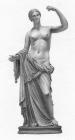 She was born out of the sea, a child of the sky god and the fertile sea womb, arising fully mature from the primordial waters. She surged from the foam, stepping delicately onto a floating seashell, and the wind of the west blew her softly to Cyprus.
She was originally known for her amorous nature, and associated with the arrival of Spring, as the bringer of joy for gods and mortals alike.
Venus and the Romans : The people of Rome had a special love for Venus. She is the mother of Aeneas, the Trojan hero who carried his father Anchises on his back from the ruins of Troy, and, after many adventures and tribulations, arrived in Italy to found the great city of Rome.
The dictator Sulla made her patron of Rome, and both Julius Caesar and the emperor Augustus named her the ancestor of their (Julian) family: the 'gens Julia'. Full of the Roman virtue of gravitas, Caesar introduced the cult of Venus Genetrix, the goddess of motherhood and marriage. She was portrayed no longer as amorous and sensual but matronly and chaste.
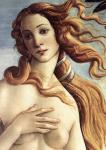 Venus as archetype : Society reflects its idealised women by archetypal images of femininity and sexuality. The rise of Christianity celebrated a sweet and vulnerable womanhood, seen particularly clearly in the image by Botticelli of the young gentle maiden. You can't fail to notice, however, that she has breasts.
Earlier cultures recognised the domain of emotion, passion and creativity as one with intense and volatile attributes of fecundity and fruitfulness. They gave us a sensual Venus with a proudly swollen belly, with prominent thighs and buttocks.
My renter, In the Outer, informs us an altercation has arisen " .. about the cover of the recent issue of Leadership which features a statue depicting in clear view some fine "marble bosom". Rather than discuss the import of what the issue was dedicated to, it appears that readers are more concerned with the supposed propriety of depicting a statue with bare breasts on the cover page of a magazine dedicated to ministers and ministry.".
You'll have to read the rest of his post, it will certainly make you wonder about people who have problems with a marble statue depicting the beauty of the female body.
I do indeed hope they are never subjected to a real live one.
Subscribe to:
Posts (Atom)
